
BULLISH 📈 : $BMIC Raises Over $433K for Post-Quantum Security Solutions
- The integration of banks and cryptocurrencies is shifting towards ensuring long-term security infrastructure.
- "Harvest now, decrypt later" attacks threaten institutions holding assets for long periods.
- BMIC employs post-quantum cryptography and zero public-key exposure to protect assets from future computing threats.
- Over $433K has been raised, indicating demand for preventative security solutions.
The conflict between banks and Bitcoin is diminishing with the approval of ETFs and a softening stance in Washington. Traditional banks are preparing to offer direct crypto products, merging legacy finance with digital assets.
This integration alters the risk profile of the industry. The loss of keys by a retail user is minor compared to a custodian bank breach, which could be systemic. As assets move on-chain, the focus is on their long-term safety. Current encryption standards face challenges from quantum computing, introducing the "harvest now, decrypt later" threat where data is collected now for future decryption.
Banks planning long-term asset holdings find current security measures inadequate. BMIC aims to bridge this gap by deploying post-quantum cryptography, providing secure infrastructure for institutional adoption.
Quantum-Proofing With AI Defense
Bringing banks on-chain requires more than regulatory changes; it demands technological upgrades. Legacy wallets expose public keys during transactions, posing risks. BMIC offers a Quantum-Secure Finance Stack that alters transaction signing and storage methods.
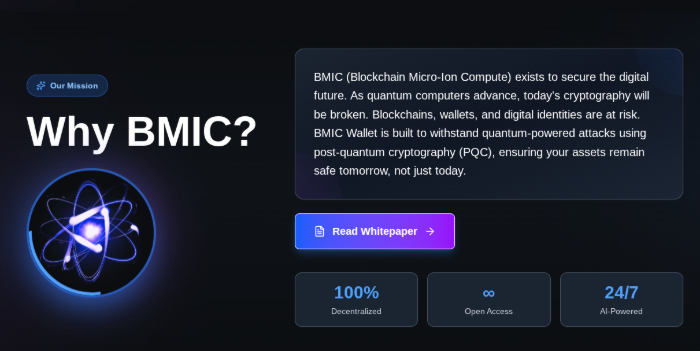
BMIC uses ERC-4337 Smart Accounts for zero public-key exposure, keeping sensitive data off the public network. It combines this with AI-enhanced threat detection, creating a "Quantum Meta-Cloud" for secure asset management.
This strategy addresses the "harvest now, decrypt later" problem, focusing on longevity rather than speed. For those building bank-crypto integration, this security architecture acts as insurance against advancing computing power.
Early Access To Post-Quantum Financial Stack
While large institutions update systems slowly, early adopters can engage with next-gen infrastructure. Security layers often gain value post-crisis, but informed investors identify such opportunities early.
$BMIC, in presale, provides access to the post-quantum sector. With over $433K raised, there's clear interest in quantum-resistant utilities. Priced at $0.049474, the token supports wallet security, governance, and burn-to-compute mechanisms, making it more than speculative. In a market of fleeting trends, quantum security marks a shift in value storage.