
Buterin says Ethereum will pivot to proofs after Hegotá
Vitalik Buterin said on September 27 that Hegotá, the post-Glamsterdam protocol upgrade expected around 2027, will likely be Ethereum’s last “normal” fork. He defined “normal” as upgrades whose technology remains recognizable to someone familiar with Ethereum in 2015. Future forks will pivot to infrastructure centered on cryptographic proofs, formal verification, and quantum resistance.
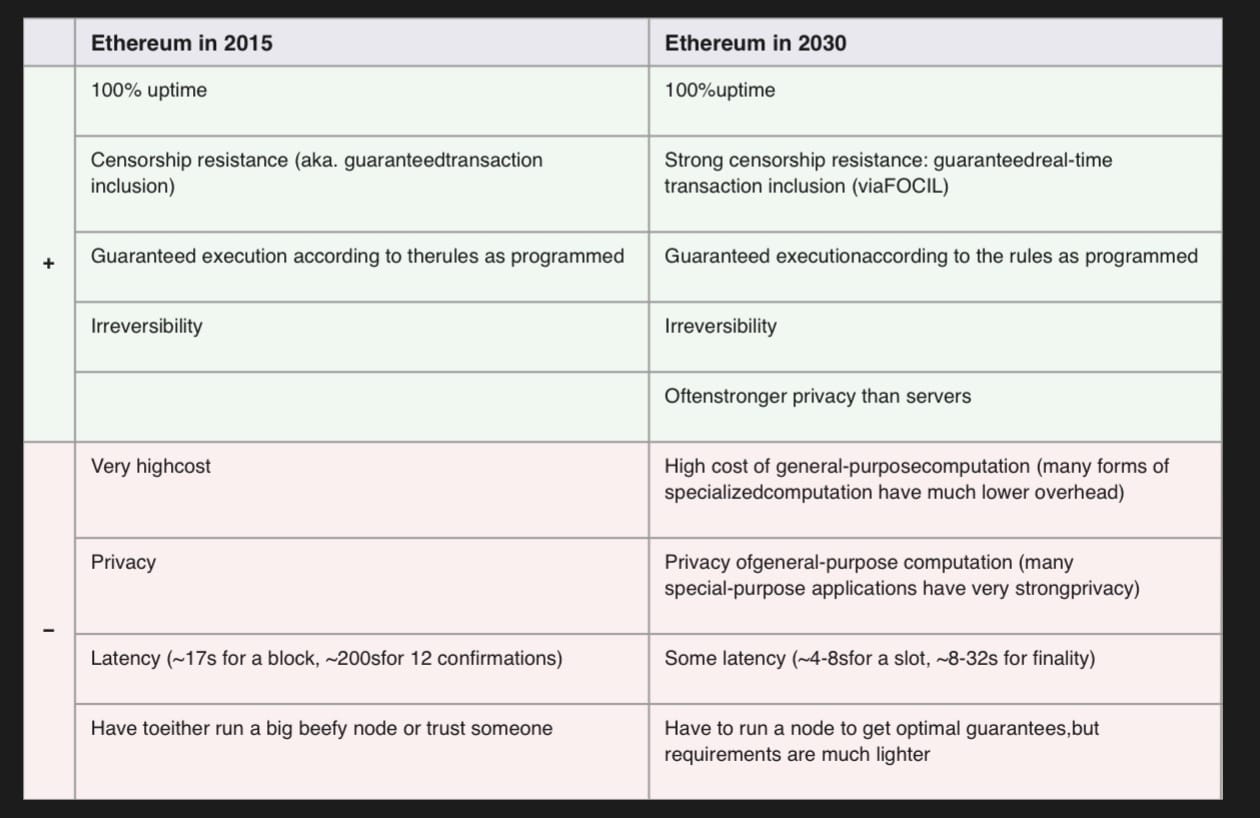
Ethereum 2030
Proof-first architecture: the shift Buterin describes
Today, full verification requires nodes to recompute every transaction: verifying balances and application rules by repeating execution. Adding more nodes does not increase capacity because each repeats the same checks.
Buterin’s proposed model, outlined in “The cryptographic world computer,” moves to zero-knowledge proofs: a processor executes transactions and outputs a succinct proof that rules were followed. Other nodes verify the proof faster than redoing execution. Separate data-availability checks ensure the underlying transaction data remains retrievable.

What changes by 2030: performance, privacy, and limits
Under this design, specialized computers handle different roles while verifying each other’s outputs. Ethereum still resolves ordering, such as conflicts between two transactions spending the same funds. Buterin targets broader privacy: concealment of wallet balance checks in addition to payment amounts, since servers can currently infer followed addresses even when sums are hidden.
Buterin’s 2030 sketch targets payment finality in 8 to 32 seconds. He notes constraints: complex applications will still face cost and privacy limits. Proof generation must become efficient for the model to be practical.
Coordination solved by proofs: lessons from past attempts
Prior efforts to distribute verification a decade ago struggled because the network lacked a reliable way to confirm each participant’s correctness. Assigning tasks to subsets of validators introduced coordination delays and risk if a group failed. Proofs supply a verifiable answer with checkable evidence without re-execution, addressing the missing piece.
Zcash demonstrates production privacy via shielded transactions, with about 4.9 million ZEC in shielded pools as of Friday. For Ethereum, reducing proof costs and coordinating parallel updates to shared state remains an engineering challenge rather than a finalized roadmap step.
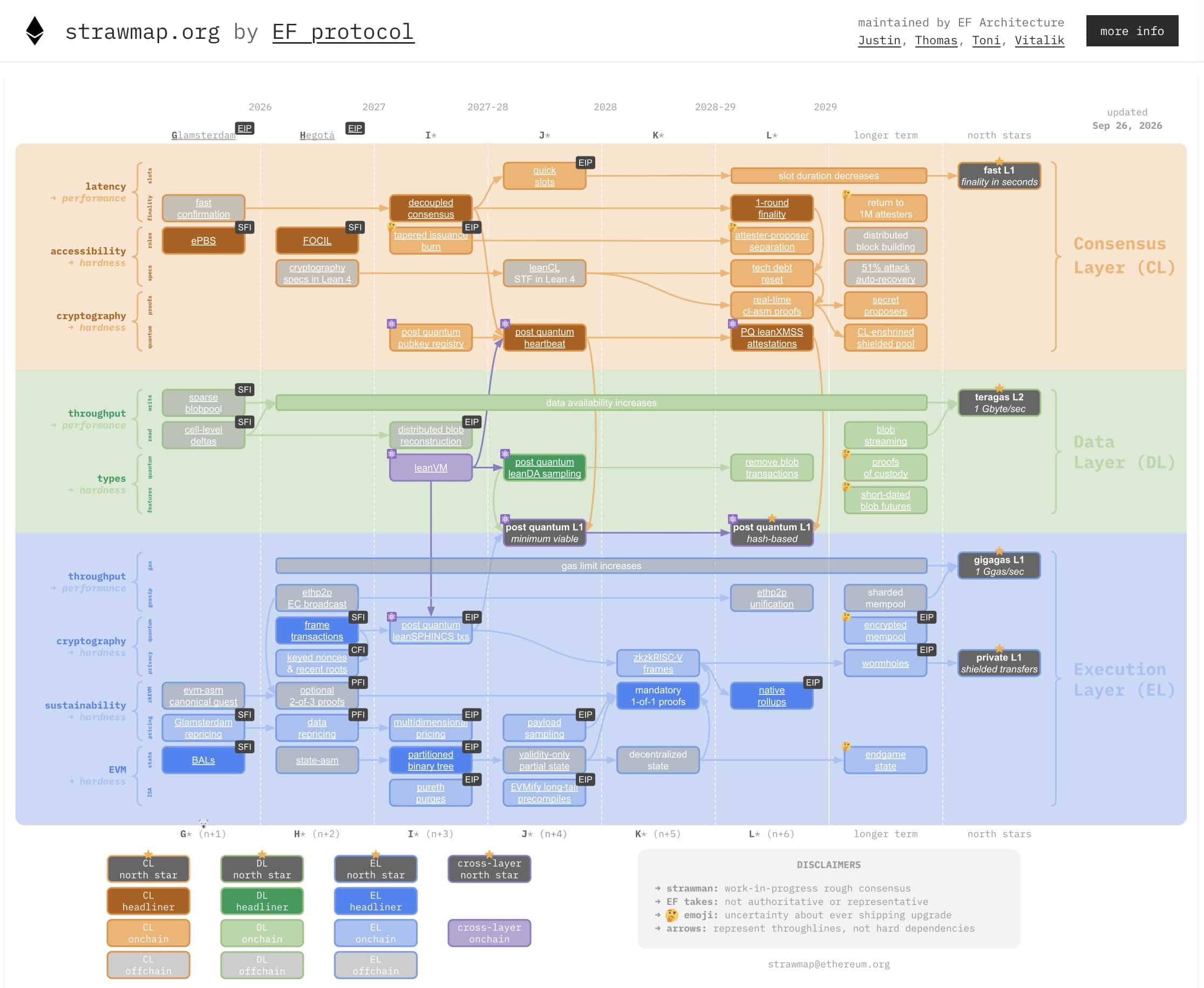
Hegotá’s scope and what follows
Hegotá is not the quantum-resistance fork. Buterin positions quantum-safe cryptography, formal verification tooling, and optimized proof-of-stake as focal points for forks after Hegotá. The shift is not fewer hard forks but a new purpose: replacing repeated computation with mathematical proof as the primary trust mechanism.