DGrid allocates 50% of DGAI supply to Premium NFT holders
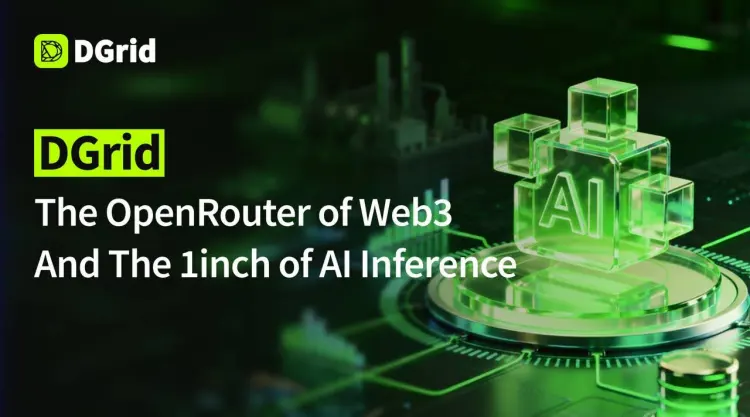
DGrid introduces a decentralized AI inference network that emphasizes transparency, community ownership, and verifiable computation. It targets current AI market issues: high costs, opaque operations, centralized control, and reliance on closed APIs that conflict with Web3 principles.
The AI market’s key issues
- Pricing is undefined and algorithms are closed.
- User data trains models without profit sharing.
- Platforms can restrict, censor, or terminate services at will.
DGrid positions itself as a Web3-native alternative that minimizes trust and supports permissionless access.
Positioning and design
DGrid combines model aggregation and optimal routing with on-chain, cryptography-native mechanisms. It aims to outperform centralized aggregators in routing, especially for niche and emerging models, through decentralized supply and incentive alignment.
Differences from Web2 aggregators
- Economic architecture: Token-based incentives and DAO governance align compute providers and developers. Rewards and coordination occur without a single authority. This design addresses incentive misalignment and trust overhead.
- Performance: Routing and serving target competitiveness with centralized platforms, with advantages in distributed, specialized model supply.
Conclusion: DGrid adds cryptographic economic coordination and verifiable infrastructure rather than another centralized layer.
Trustless inference: technology and process
DGrid cites an academic framework on verifiable AI inference (Ref: https://arxiv.org/abs/2512.16317) from its co-founders, focusing on quality assurance in untrusted environments.
1. Proof of Quality
Verification Nodes randomly audit inference outputs. Failures lead to slashing of staked $DGAI. Every inference becomes auditable and traceable. This creates deterrence against low-quality or malicious results.
2. Modular, elastic architecture
- Decentralized inference network: No single point of failure, globally distributed nodes.
- AI RPC interface: Standardized developer gateway similar to blockchain RPC. Single interface for global LLMs and AI models.
- Node incentive economy: Open participation for compute providers with on-chain rewards.
3. Operational flow
- Developers send requests via AI RPC, specifying models such as Llama 3.
- Network routes to an optimal node using staking and performance metrics.
- Blockchain layer manages PoQ verification, settlement, and rewards.
- Users receive verified results with targeted lower costs.
Ecosystem and backing
Investors include Waterdrip Capital, IOTEX, Paramita, Abraca Research, CatherVC, 4EVER Research, and Zenith Capital. The roadmap highlights:
- Global decentralized compute network.
- Integrations with DeFi, GameFi, SocialFi, and AI Agent protocols.
- Partnerships with Web3 infrastructure providers and model vendors.
Economics: Premium NFT and $DGAI
Premium membership
DGrid Premium NFT grants access to premium features for aggregated top-tier models on DGrid.AI. Pricing: $1,580 for the first year, $200 annually thereafter. Target users: high-frequency AI users, developers, and teams seeking consolidated access and lower aggregate costs.
Token distribution
50% of total $DGAI supply is allocated to Premium NFT holders. The NFT acts as a long-term credential tied to network growth. Value accrual is linked to inference volume and AI Agent activity on the network.
Stated mission
DGrid seeks to decentralize AI inference into a verifiable public utility, aligning with Web3 principles and returning 50% of token value to the community. Premium NFT sales began on January 1, 2026.
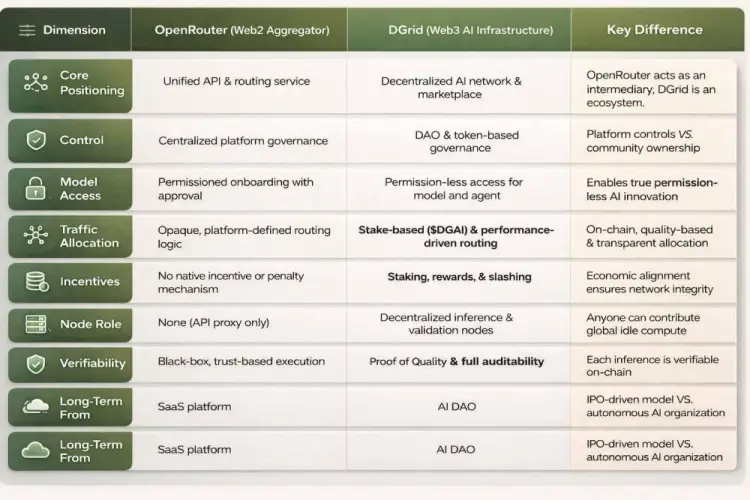 Fundamental Distinctions from OpenRouter: Web3-Native vs. Web2 Optimization
- Official website: https://dgrid.ai
- X/Twitter: https://x.com/dgrid_ai
- Technical documentation: https://docs.dgrid.ai
- White paper: https://static.dgrid.ai/dgrid_litepaper.pdf
Authors credited by the source: News BTC
Published by Holder based on an external source.