
Solana RWA hits $4B two days after 350ms block time cut
Solana’s real-world-asset total value surpassed $4 billion on August 23, two days after validators activated SIMD-0525 at epoch 1020, reducing slot time from 400ms to 350ms. In the prior six days, Solana Compass recorded average user throughput of 1,710 transactions per second and 27.7% compute utilization at the 400ms ceiling.
RWA composition and comparative context
Motley Fool reported Solana’s 30-day RWA inflows of $263 million through August 19 and a 10.6% growth rate. Ethereum saw $337 million in RWA outflows and a 1.3% growth rate over the same period. Tokenized U.S. Treasuries on Solana reached $1.2 billion, up 16.1% over 30 days. Backed Finance’s xStocks lists over 60 U.S. stocks and ETFs as SPL tokens tradable on Raydium, Jupiter, and Kamino Finance. Ethereum’s RWA base remained larger at approximately $17.2 billion as of August 22. Solana’s $4 billion marked a new high for its RWA market.
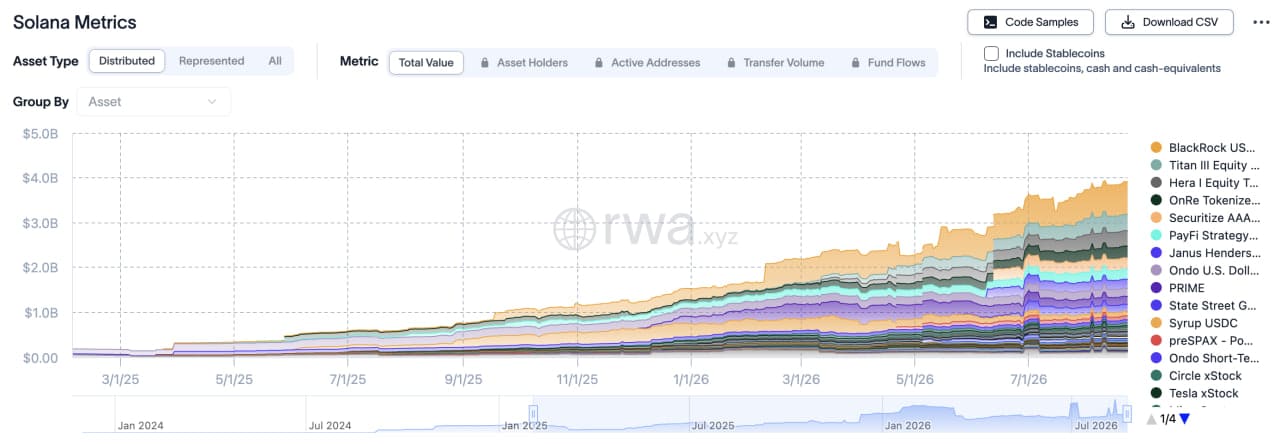
Source: RWA.XYZ
SIMD-0525: slot-time roadmap and compute budgets
SIMD-0525 defines sequential 50ms slot-time reductions: 400ms to 350ms, then 300ms, 250ms, and 200ms. Each step requires new supermajority validator approval. Co-founder Anatoly Yakovenko noted Solana moved from 800ms to 400ms shortly after launch, framing 400ms as a baseline. Jacob Creech confirmed epoch 1020 activation on X. Compute budgets scale with slot-time: the per-block ceiling moved from 100 million compute units at 400ms to 87.5 million at 350ms, maintaining roughly 250 million compute units per second, per George Tsagkarakis’s technical breakdown on egamers.io.

Slot time governs block production attempts, while finality is when a block becomes irreversible. Under TowerBFT, finality is approximately 12.8 seconds. The Alpenglow redesign targets median finality near 150 milliseconds in simulation and is slated for Agave 4.3 in October 2026.
Infrastructure progress and rollout process
Testnet sustained eight hours of stable 350ms blocks in early August before mainnet activation. Further reductions toward 200ms will follow discrete stages, each requiring a stability window and new validator approval rather than a single network-wide change.