AAVE Is Down 70% — Why the Largest DeFi Protocol Is Falling
On June 27, 2026, Aave activated Aavenomics 3.0. According to Aave DAO and DefiLlama, 100% of the revenue from the protocol and the GHO stablecoin is now directed to on-chain AAVE buybacks. The mechanism buys roughly 292 tokens per day.
The “half as expensive” thesis and what is wrong with it
Against this backdrop, a simple thesis is being heard in the community again. AAVE is trading at almost half the price it had a year ago. The fundamentals remain the same, so this is an undervalued asset and a candidate for a medium-term buy.
The first part of the thesis looks close to true. AAVE is now trading around $96, compared with roughly $323 a year earlier. In price terms, that is a decline of about 70%, even deeper than the thesis itself suggests.
The problem is in the second part. The fundamentals have not stayed the same.
Aave’s TVL has fallen from roughly $30 billion to $14.3 billion year over year. That is a decline of about 53%. From the intrayear peak of around $46 billion, the drawdown is even deeper.
TVL, or total value locked, is the amount of money users keep in the protocol. For Aave, this means deposits and collateral in lending pools.
The metric is rough. It shows the size of the protocol and the level of user trust, but it is not the same as revenue. Two protocols with the same TVL can earn differently because of rates, asset composition, loan demand, and fees.
The correct formulation is different. AAVE has become roughly 70% cheaper, and TVL has fallen along with it, by about 53%. The token price and the protocol’s collateral have declined in sync, which is closer to a warning signal than to pure undervaluation.
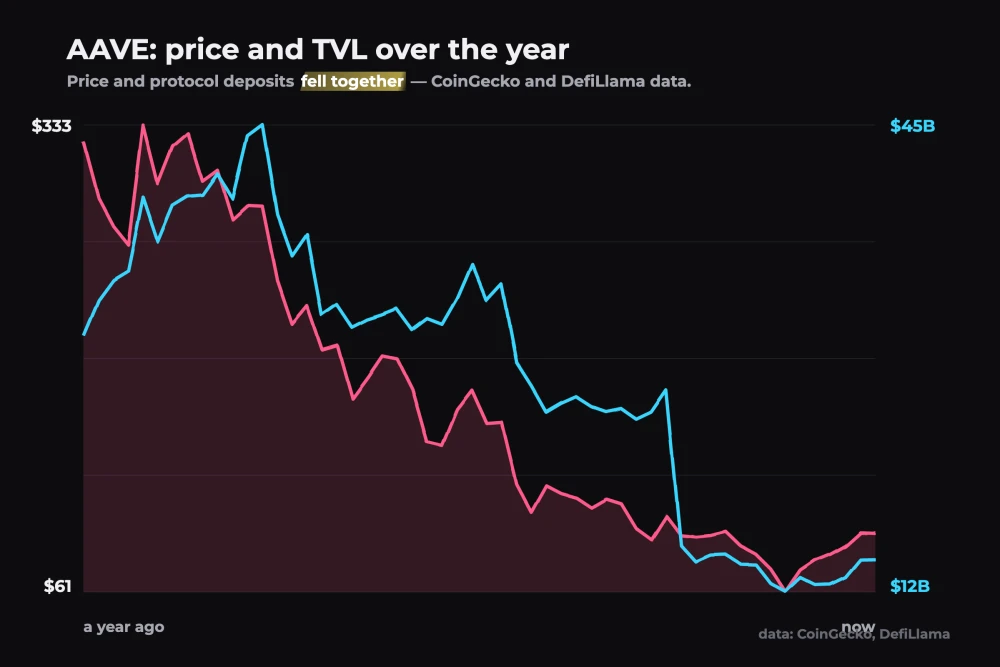
The undervaluation thesis does not disappear because of this. It needs to be built through revenue, protocol margin, GHO’s share, the buyback volume under Aavenomics 3.0, and how much economic value reaches AAVE holders.
The slogan “half as expensive with the same fundamentals” is too convenient for a bullish bet. It hides the main risk. The market may have repriced the token not only because of DeFi fatigue, but also because of falling TVL, lending risks, and doubts about how much buybacks will change demand for AAVE.
Aave fundamentals: revenue, market share, GHO
Aave remains the largest DeFi lending protocol. By TVL, it is still ahead of Morpho. Roughly $14.3 billion versus $11.8 billion for its closest competitor.
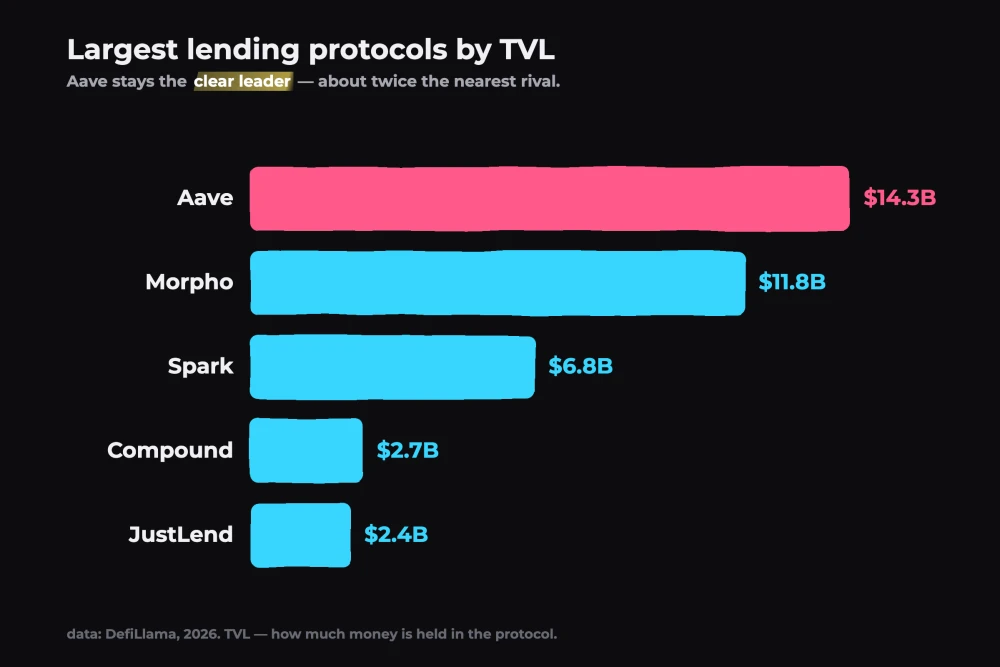
The gap no longer looks unreachable, but Aave has a broader base. More markets, more assets, more historical data on liquidations and risks. For a lending protocol, this matters because borrowers go where there is liquidity. Liquidity providers go where there is demand for loans.
The main argument in favor of Aave as an undervalued asset is linked to revenue. In 2025, the protocol collected around $907 million in fees. By mid-2026, the amount was around $333 million.
This is not yield from a printed token. Borrowers pay interest to use liquidity. Part of this money goes to capital providers and the protocol. This flow is called real yield. It is yield from real fees, not from issuing new tokens.
Against this backdrop, AAVE’s market capitalization of around $1.3–1.5 billion looks low relative to the scale of the protocol. If we roughly compare it with 2025 revenue of $907 million, we get a level of around 1.4–1.7 times annual revenue.
This is not a ready-made conclusion that the token is cheap. AAVE has a problem. Not all revenue automatically turns into profit for the token holder. Part of the income remains in the protocol’s economy. Part depends on DAO parameters, liquidation risks, incentives, and future decisions on buybacks or fee distribution.
A separate layer is connected to GHO, Aave’s own stablecoin. Its capitalization is around $584 million. It gives the protocol another cash flow. Users borrow GHO against collateral, and the interest on these loans goes into the Aave system.
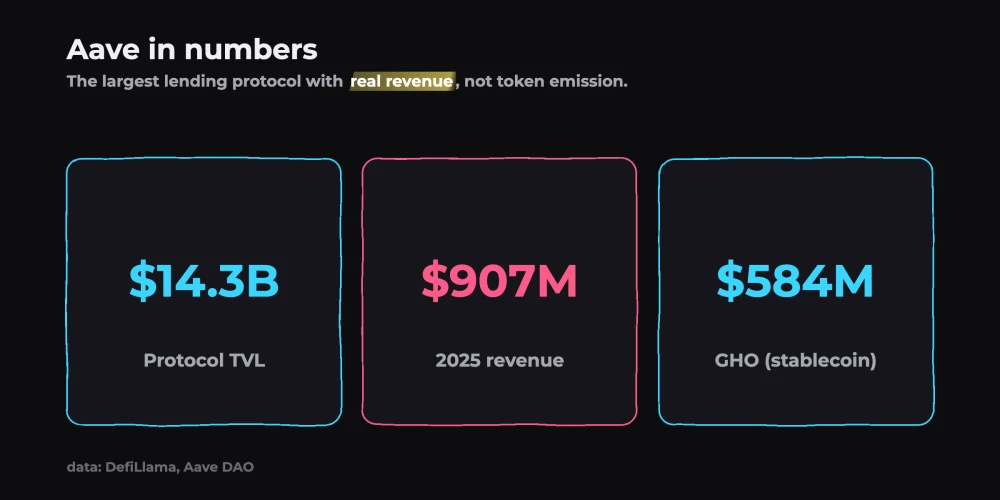
For Aave, GHO is useful because the protocol gets a product on top of the lending market. If demand for GHO grows, Aave earns not only on classic loans in USDC, ETH, or other assets. The protocol also earns on issuing its own debt inside its ecosystem.
By market rank, AAVE is holding around #48. The market values it below many tokens with lower revenue and a weaker connection to cash flows. This creates a debatable but understandable thesis. An old DeFi protocol with real fees may trade as an undervalued asset if an investor believes these fees will eventually reach the token more directly.
Asset card: AAVE on Holder.io. DeFi sector.
Aavenomics 3.0: revenue turns into token buybacks
On June 27, 2026, Aave activated Aavenomics 3.0. The Aave Will Win initiative passed a vote in April 2026 and received around 75% of the votes.
The main change concerns revenue. 100% of protocol and GHO revenue is now directed to on-chain AAVE buybacks. The mechanism works automatically and buys about 292 AAVE per day.
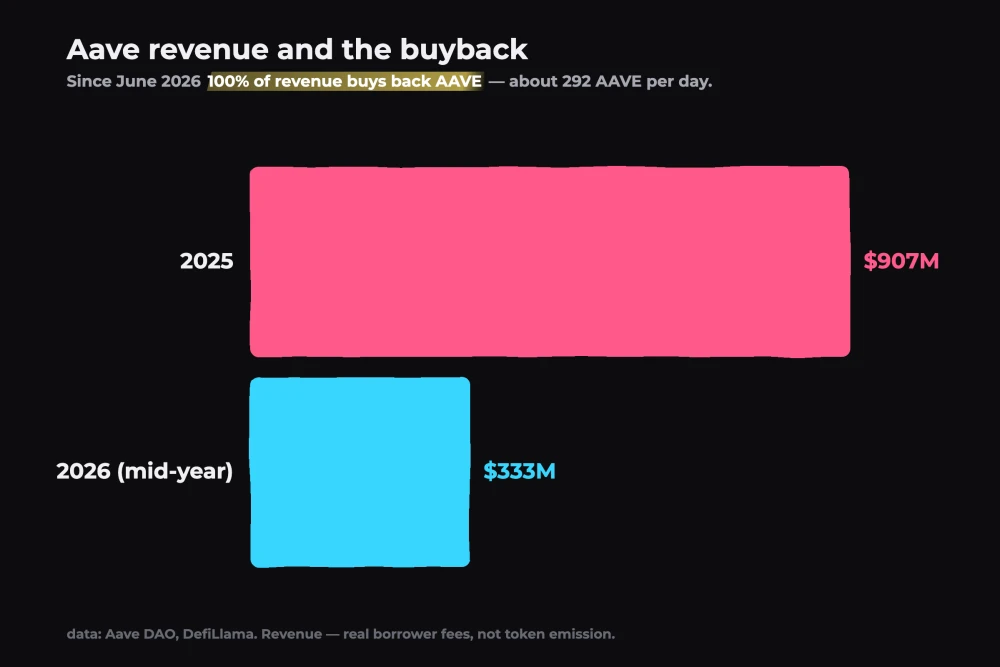
For valuation, this changes the mechanics of the token. Previously, Aave could earn fees, but an AAVE holder did not always see a direct link between the protocol’s income and demand for the token. After Aavenomics 3.0, this connection became direct. The protocol receives revenue, and the treasury buys AAVE on the market.
This does not make AAVE a stock and does not guarantee price growth. But the token gets a clear channel for value return. The higher the revenue, the greater the regular demand from the protocol.
This is where the argument in favor of undervaluation appears. If the market valued AAVE as an old DeFi token with diluted value capture, the new model gives a reason to recalculate multiples. Protocol income now turns into token purchases.
An additional factor is connected to the SEC. The regulator closed its four-year investigation into Aave. For valuation, this removes part of the regulatory discount. An investor needs to price in less risk of sudden pressure from the U.S. regulator.
The limitation is simple. Buybacks strengthen the link between the protocol’s business and the token, but they do not cancel DeFi cyclicality. If Aave and GHO revenue falls, buyback volume also falls. Along with it, fundamental demand weakens.
How to value a DeFi protocol by fundamentals
Metrics from equities are suitable for DeFi, but they need to be read with an adjustment for tokenomics. A protocol can have revenue, users, and market share. At the same time, the token does not always receive direct benefit from this.
P/F, price to fees, shows how many times the token’s market capitalization exceeds the protocol’s annual fees. If Aave’s capitalization is conditionally $10 billion and annual fees amount to $500 million, the P/F is 20. The lower the indicator, the cheaper the protocol is relative to its fee flow.
P/S, price to sales, is closer to the familiar business valuation by revenue. In DeFi, sales usually means protocol revenue after payments to liquidity providers and other participants. The methodology differs across analytics services. Therefore, P/S is better compared within one data table, rather than between different sources.
TVL shows the amount of capital users keep in the protocol. High TVL by itself says little. Capital can come in for temporary incentives and leave after the program ends. The trend matters.
If TVL grows together with fees, the protocol’s base is expanding. If TVL falls while the token price holds up, the market may be late in repricing risk. It is especially bad when TVL leaves for competitors and the protocol’s revenue does not compensate for the outflow.
Separately, it is necessary to look at where yield comes from. Real yield means payouts from real fees. These are loan interest, liquidation fees, stablecoin income, and payments for using the product. Such yield depends on demand for the service.
Emission-based yield works differently. The protocol distributes its own token to attract capital or users. This works like marketing, but it dilutes holders and often disappears along with the incentive budget.
Tokenomics answers the main question. Does the token receive part of the value created by the protocol. Three things are important here:
- buybacks
- revenue distribution
- supply inflation
Even strong revenue does little to help the price if new tokens are constantly entering the market and there is no mechanism that links protocol income with demand for the token.
Revenue must be distributed across different sources. For a lending protocol, risk is higher if almost all fees come from one network, one type of collateral, or one product. For Aave, this means it is necessary to look not only at loans. GHO, liquidity distribution across networks, collateral composition, and dependence on individual markets matter.
A bet on undervaluation in DeFi means a protocol that is cheap relative to income, earns from real usage, and returns part of the value to the token. A coin that has simply fallen in price does not fit this definition by itself.
Risk number one: the team and founder
Old DeFi protocols have a risk that is poorly visible in multiples. This is dependence on a public founder. For Aave, this is Stani Kulechov. If the market believes that decisions, reputation, and development direction are too tied to one person, a key-person risk discount appears in the price.
This is not an accusation or an assessment of personal motives. For an investor, the source of uncertainty matters. What will happen to the protocol if the founder changes role, sells part of the position, enters into conflict with governance, or the market starts doubting the alignment of interests between the team and token holders.
In 2026, Aave was surrounded by discussion of reports about a possible sale of an AAVE stake to Kraken’s entity, Payward, at a discount to the market. Kulechov publicly denied this and said there was “no chance” of selling at a 70% discount. For the price, it is not only the final fact that matters. The market reaction itself also matters, because such news quickly tests trust.
Separately, sales of part of holdings and disputes over protocol development through governance also entered the discussion. For mature DeFi, this is a normal zone of tension. The token is already traded as a financial asset, while governance remains a political process with different interest groups.
In the undervaluation thesis, this works simply. The higher the distrust of the founder, team, or governance structure, the less an investor is willing to pay for the same protocol income. Even strong fees and sustained demand for the product do not remove this discount if the market doubts who will receive the economic value.
The main question for a buyer of AAVE and other large, proven DeFi protocols is this. Is this a temporary discount caused by noise and weak market sentiment, or a fair premium for governance risk. In the first case, the token may be undervalued relative to the business. In the second, the low multiple becomes the price of uncertainty.
Risk number two: contagion through Ether wrappers
Contagion in DeFi means a chain reaction. A problem in one asset reaches the protocol through collateral, liquidations, and debt. For Aave, this risk is linked to the fact that wrappers of staked Ether are increasingly used as collateral for loans.
This refers to LST and LRT tokens. These are stETH, wstETH, weETH, rsETH. LST, or liquid staking token, is a liquid staking token. LRT, or liquid restaking token, is a restaking token.
The mechanics look safe while the market is calm. A user deposits wstETH or another ETH derivative as collateral, borrows ETH or stablecoins, sometimes buys a similar asset again, and repeats the cycle with leverage.
The problem begins if the wrapper loses its peg to Ether. During a depeg, collateral becomes cheaper faster than the debt. A depeg means the loss of the price peg of one asset to another. Positions enter liquidation, liquidators sell collateral, and price pressure grows. This is how a local imbalance turns into protocol risk.
The scale is no longer small. In October 2025, wstETH became the third-largest collateral on Aave. A separate Lido market allowed LTV of up to 95%. LTV shows how much can be borrowed against collateral. At 95%, the safety buffer almost disappears.
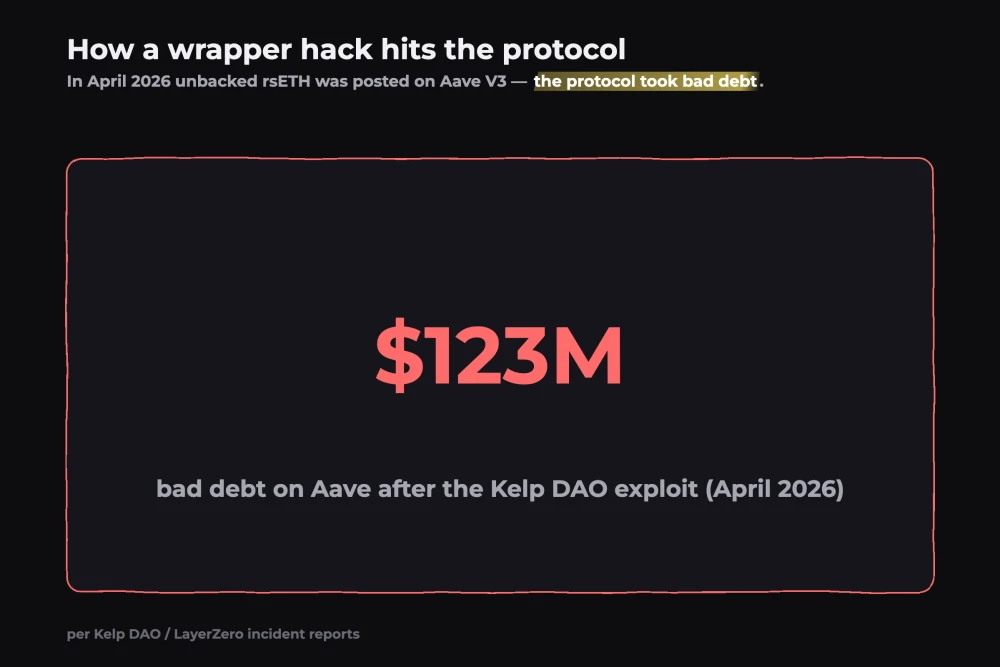
This is not an abstract threat. On April 18, 2026, the Kelp DAO exploit through a LayerZero bridge vulnerability made it possible to issue around 116,500 unbacked rsETH. These tokens were deposited as collateral on Aave V3. After that, the protocol was left with around $123 million of bad debt.
For valuing AAVE, this changes the question. It is necessary to look not only at income, fees, and market share, but also at collateral quality. The assets accepted by the protocol, limits, and the speed with which governance cuts risk parameters under stress matter.
The more deeply Aave is integrated with Ether wrappers, the more it inherits their risks. The status of a large, proven protocol does not cancel the risk of a depeg, bridge, oracle, or external protocol whose token sits as collateral.
On this topic, it is worth separately looking at the wstETH card and the liquid-staked ETH sector. This is where part of the risk forms, which then enters Aave’s balance sheet.
Value or value trap: how to tell the difference
A value trap means an asset that looks cheap by multiples or relative to a previous peak, but is cheap for a reason. In DeFi, such a trap often looks like an old, strong protocol at a big discount. Then it turns out that revenue, TVL, and market share are falling at the same time.
The first filter is linked to revenue. If a protocol earns in real fees, rather than in tokens it prints itself, it has a base for revaluation. If income relied on emissions, liquidity subsidies, or temporary farming, the low token price may reflect disappearing demand.
The second filter concerns returning value to token holders. For an undervaluation approach, it is not enough that the protocol is useful to users. It is necessary to understand whether the token receives part of that utility through buybacks, fee distribution, staking with a clear source of income, or another working mechanism.
The third filter is linked to TVL and market share. A TVL drawdown by itself does not make an asset a trap. Capital leaves DeFi cyclically, yields change, and the cost of risk rises. It is worse when TVL falls together with revenue, and users leave for new protocols and do not return.
For Aave, this framework gives a mixed picture. The strength is that the protocol remains one of DeFi’s main money markets, generates fees, and has a recognizable brand among large participants. Aavenomics with buybacks adds a direct channel for value return, if revenue holds up and the buyback does not turn into a symbolic gesture.
The removal of part of the regulatory overhang is also important for valuation. If uncertainty around the token or governance model decreases, the market may recalculate the discount. But this works only together with operating data. Revenue, debt, collateral quality, and borrower activity matter.
Weak points cannot be covered by references to past leadership. Aave’s TVL has declined, and competition has become tighter. Morpho, Spark, and other lending models are taking attention, liquidity, and certain categories of users. If new protocols grow at the expense of segments where Aave used to be the default choice, this is no longer temporary noise.
A separate risk is connected to the structure of collateral and wrappers. Aave is connected to liquid staking, restaking, stablecoins, and tokenized positions. Therefore, a problem in one layer can move into the lending market through liquidations, discounts, and loss of liquidity. The more complex the collateral, the more important it is to look not only at LTV. It is necessary to understand where the ultimate risk arises.
Founder and governance risk also enters fundamental valuation. For an old DeFi protocol, code and TVL matter. No less important is how decisions are made, who influences risk parameters, how the DAO reacts to crises, and whether there is a concentration of power that can damage trust.
A practical check looks like this:
- revenue is holding up or growing without relying on emissions
- the value return mechanism is already working
- TVL has stabilized after the decline
- market share is not moving to Morpho, Spark, and other competitors too quickly
- collateral, team, and governance risks have not moved from theory into damage
If most of these points are met, an old DeFi token can be considered a candidate for revaluation. If the price falls together with revenue, TVL, and market share, “cheapness” may be a trap.
This framework does not say whether to buy or sell AAVE. This is not investment advice. The decision, position size, and exit scenario remain with the reader.
FAQ
The FAQ helps quickly check the main theses on AAVE, Aavenomics 3.0, and protocol risks. The answers below do not replace independent analysis.
Is it true that AAVE is half as expensive as a year ago?
Even more: the price has fallen by roughly 70% year over year. And TVL has declined along with it, by about 53%.
This means the “same business at half the price” thesis is inaccurate. The market is repricing the token amid deterioration in some operating metrics, not only because of a change in sentiment.
What is Aavenomics 3.0?
Aavenomics 3.0 means a model in which 100% of the revenue from the protocol and the GHO stablecoin is directed to on-chain AAVE buybacks.
The mechanism was activated on June 27, 2026. This is important for the undervaluation thesis. The token now has a direct channel for value return, which can be tracked by actual buybacks, rather than promises.
Is Aave still the largest lending protocol?
Yes. By TVL, Aave is roughly twice as large as its closest competitor, Morpho.
But leadership by itself does not protect against margin compression, liquidity migration, and errors in the risk model. It is important to look not only at ranking, but also at the dynamics of TVL, revenue, and market share.
What is Aave’s main risk?
There are two major risks:
- dependence on the founder and governance
- contagion through Ether-wrapper collateral
If decisions are concentrated around a narrow group of people, the token carries governance risk even with a strong product.
If one of the wrapper assets loses backing or a bridge breaks, the problem can move into Aave’s lending markets through liquidations and bad debt.
What happened with Kelp DAO?
In April 2026, a LayerZero bridge exploit led to the creation of unbacked rsETH. These tokens were used as collateral on Aave.
After that, around $123 million of bad debt formed on the protocol. This case showed that Aave’s risk lies not only inside the protocol itself. It depends on the quality of external assets, bridges, and oracles.
How do you distinguish value from a value trap?
It is necessary to check whether the drawdown in metrics is being bought, or only the price decline. For AAVE, six questions matter:
- whether protocol revenue is holding up
- whether TVL is stable after the decline
- whether competitors’ share is growing, especially Morpho
- whether AAVE buybacks under Aavenomics 3.0 are taking place
- whether bad debt is accumulating
- whether governance reduces risk rather than adding it
If the price falls faster than the metrics and buybacks work, this looks like an undervaluation scenario. If TVL, revenue, and market share continue to move downward, the discount may be a trap.