How to Make Money With Crypto in 2026: A Beginner’s Guide to Methods, Risks and First Steps
Spot Bitcoin ETFs, launched in January 2024, had accumulated more than $137 billion in assets by 2026. According to Q1 2026 data, Bitcoin is now held through them by over 2,000 institutional investors. The largest fund by assets is BlackRock’s iShares Bitcoin Trust (IBIT).
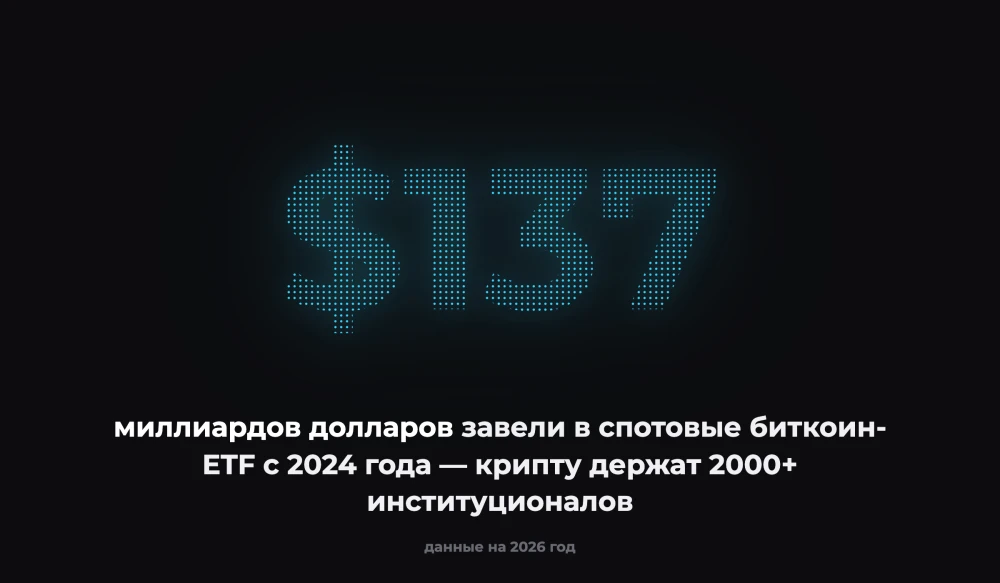
Banks, asset managers, and pension funds have joined the crypto market.
For a beginner, this means one thing. Making money with cryptocurrency has become technically easier, but the risk remains.
Even Bitcoin can fall by tens of percent. Altcoins can go to zero even faster.
Most beginners lose money because of the same repeated mistakes. They buy during hype, use leverage without experience, and enter scam projects from chats and ads.
Next, we’ll look at ways to earn money. Where there is a real chance, where the risk is higher than the return, and how to get started without unnecessary losses.
Crypto Market in 2026: What Has Changed
After spot Bitcoin ETFs launched in the U.S. in January 2024, it became easier for large investors to add cryptocurrency to their portfolios through familiar exchange infrastructure.
In April 2024, Bitcoin’s fourth halving took place. The block reward for miners was cut in half again.
In the U.S., there is now more regulatory clarity for companies and funds working with crypto assets.
For beginners, the takeaway is simple. The market has become more mature and closer to traditional finance, but the risk remains. Prices can still move sharply in both directions. In 2026, crypto remains a highly volatile instrument.
How Much You Can Earn from Different Scenarios and Why
Earnings in cryptocurrency come from three sources. These are the increase in an asset’s price, rewards for using coins in protocols, and the trading difference between buying and selling.
In each case, income depends on time, amount, fees, taxes, and risk.
Promises of “10% per day” almost always mean excessive risk, a pyramid scheme, leverage, or a lucky short period being presented as the norm.
With that kind of return, capital would theoretically grow dozens of times in a month. The market does not work like that consistently.
A series of losing trades, liquidation, or a hack can wipe out a deposit faster than it has time to grow.
For beginners, it is safer to think in scenarios. For example, what happens if the price drops by 30%, if staking yield decreases, if fees eat up part of the profit, or if the asset cannot be sold quickly.
| Method | Return | Risk | Difficulty | Entry threshold |
|---|---|---|---|---|
| Long-term holding (HODL / DCA) | average, over years | medium | low | from $10 |
| Staking | low (≈3–10% per year) | low–medium | low | from $10 |
| Lending | low–medium | medium (platform risk) | low | from $50 |
| Trading (spot) | high, unpredictable | high | high | from $50 |
| Futures (with leverage) | maximum | extreme | high | from $50 |
| DeFi farming | high | high (bugs, rug pulls) | high | from $100 |
| Airdrops | one-time, unpredictable | medium (time, scams) | medium | ≈$0 |
| Copy trading | same as the trader | high | low | from $50 |
| Arbitrage | low per trade | medium | high | from $500 |
| Mining | low (in 2026) | medium | high | high (equipment) |
| Affiliate programs | depends on traffic | low | low | ≈$0 |
The main rule is simple. The higher the promised or potential return, the higher the risk of losing money.
Long-term holding of major assets usually means fewer actions and fewer mistakes.
Active trading requires skill and time. Schemes with quick interest payments usually shift the risk onto beginners.
Ways to Earn Money with Cryptocurrency
Earning in crypto can be passive or active. The fewer actions involved, the lower the chance of making a serious mistake. The higher the return shown on the screen, the more often liquidity, leverage, smart contracts, or platform risk are hidden behind it.
Below are the main methods. For a beginner, one or two are usually enough, rather than trying everything at once.
Long-Term Investing: HODL and DCA
HODL means buying cryptocurrency for months or years without trying to catch every price move. For a beginner, this is the simplest format. Fewer trades, fewer fees, fewer emotional decisions.
DCA means buying in parts on a schedule, for example once a week or once a month for the same amount.
This way, you do not need to guess the “bottom.”
The market risk remains. The price can fall for years, and buying on a schedule does not guarantee profit.
Trading: Spot and Futures
Trading means actively buying and selling based on price fluctuations. On spot, you buy a coin and sell it for more if the market moves in the right direction.
Futures allow you to trade with leverage. Profit grows many times over, but so does the loss.
Beginners are better off starting without leverage. One sharp candle can close a position with the loss of the deposit.
Another cost is fees. With frequent trades, they noticeably cut into the result. It is better to compare platform conditions in advance in the exchanges section.
Staking
Staking means locking coins in a Proof-of-Stake network for a reward. The estimated yield is often in the range of 3–10% per year. The exact rate depends on the coin, network, validator, and withdrawal conditions.
This method is suitable for those who already hold PoS coins and do not plan to sell them in the near future.
The main risk is simple. The reward is paid in the coin, and the coin itself may fall in price more than you earn from staking.
Lending: Earning Interest by Lending
Lending means lending cryptocurrency for interest. It is used through CeFi platforms, where a centralized service takes the money, or through DeFi protocols, where loans work through smart contracts.
The income looks easier to understand than in trading. You deposit an asset and receive interest.
But the risk lies with the platform or protocol.
In 2022, Celsius, a major crypto lending platform, froze withdrawals and filed for bankruptcy. For users, this ended in long proceedings and losses.
Mining
Mining is the process of earning cryptocurrency using equipment. Miners connect devices to the network, spend electricity, and receive rewards if their computing power participates in processing blocks.
In 2026, solo mining for a beginner often does not work out economically. Equipment is expensive, network difficulty is high, and the price of electricity determines almost everything.
It is more realistic to look at pools or cloud mining, but there are many scams there.
Promised returns without transparent hashrate and contracts usually mean a risk of losing money.
Airdrop Hunting: Airdrops
Airdrop hunting means looking for projects that may distribute tokens for early activity. A user tests the network, makes swaps, adds liquidity, mints NFTs, votes, uses bridges, or completes tasks in a testnet.
Money is sometimes not needed at the start, especially if the project works in a test network. Time is almost always needed. You have to keep a table of activities, track deadlines, pay fees in main networks, and not abandon the wallet after one action.
The risks here are different.
Scam airdrops ask you to connect your wallet to a malicious website, sign a dangerous transaction, or enter your seed phrase.
A seed phrase must not be entered anywhere except in the wallet during recovery. For airdrops, it is better to use a separate wallet with a small amount for fees.
DeFi: Liquidity Pools and Farming
In DeFi, you can add liquidity to pools and receive part of the fees or protocol tokens. For example, a user deposits a pair of assets into a pool, and traders swap them through that pool.
The yield may look high. The risk is high too.
There are impermanent losses when the prices of assets in the pair diverge. There are smart contract bugs. There are rug pulls, when the team or large holders withdraw liquidity and crash the token.
Beginners are better off starting with small amounts and understandable protocols. The highest percentage in a new farm usually means increased risk.
Copy Trading
Copy trading means automatically copying another trader’s trades on an exchange. You choose a trader, set the amount and limits, and the system copies their entries and exits.
The entry barrier is low because you do not need to build a strategy yourself. But someone else’s drawdown is copied along with someone else’s trades. Past results do not protect against future losses.
This method is suitable only with amount limits and a pre-set stop for losses.
Arbitrage
Arbitrage means earning on price differences between exchanges, pairs, or networks. For example, a coin is cheaper on one platform and more expensive on another. A trader tries to buy where it is cheaper and sell where it is more expensive.
In practice, the windows are small. You need speed, capital, and to account for fees, withdrawal limits, network delays, and the risk that the price equalizes before the transfer is completed.
For beginners, arbitrage often seems easier than it is in a real trade.
Affiliate Programs
Affiliate programs pay a percentage of the fees or actions of invited users. Exchanges, wallets, analytics services, and crypto projects provide referral links, and the affiliate brings in traffic.
Investing in cryptocurrency is not required here, but you need an audience. A website, Telegram channel, YouTube, newsletter, or community can work.
The risk is less financial and more reputational. If you promote a questionable service, users’ losses will come back to you as distrust.
What to Invest In: Coin Categories 2026
It is better to start choosing coins by looking at categories. Then you can analyze specific projects. Why the token is needed, who uses it, where demand comes from, and what risks the sector has.
Directly buying “a coin that will go up” rarely creates a sustainable strategy.
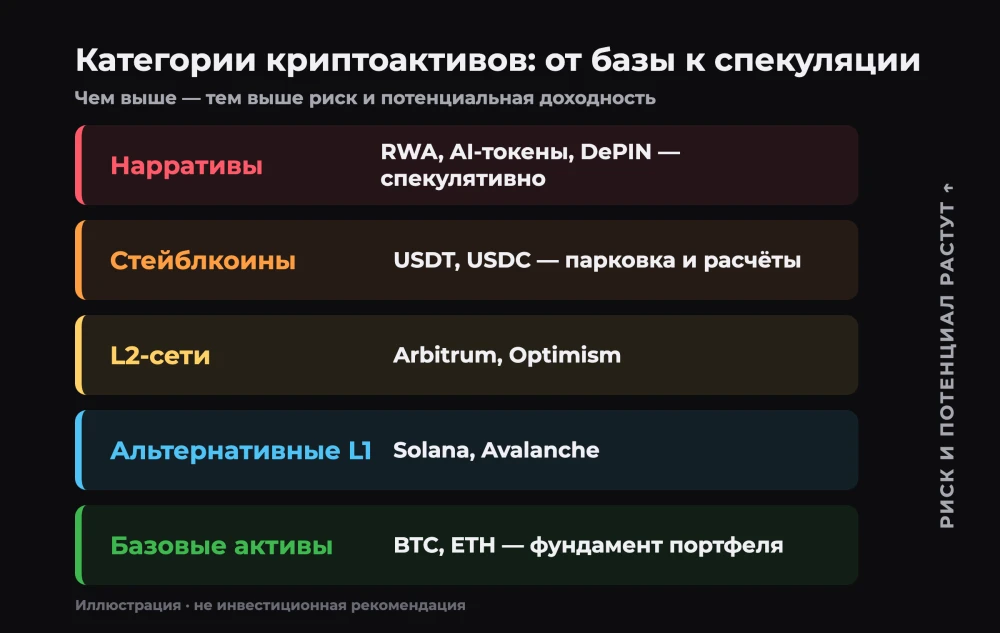
Bitcoin is often seen as the most conservative crypto asset within the market. It has a clear issuance model, high liquidity, and a long trading history.
Ethereum is a bet on infrastructure. Smart contracts, DeFi, NFTs, asset tokenization, and L2 networks. Its risks are linked to competition, fees, and the ecosystem’s dependence on application development.
Alternative L1s
Alternative L1s are networks that compete for developers, users, and applications. They include Solana, Avalanche, and other layer-1 blockchains.
Solana focuses on high throughput and cheap transactions.
This is convenient for trading, memecoins, NFTs, and mass-market applications.
But investors need to look at network stability, token distribution, and how much activity depends on speculative cycles.
Avalanche is interesting because of its modular architecture and separate subnets for applications. Here it is important to check the technology and real demand. Look at transaction volume, TVL, the number of active developers, and real integrations.
L2 Networks
L2 networks are built on top of Ethereum and help reduce transaction costs. The most notable examples are Arbitrum and Optimism.
Their tokens are often linked to network governance, ecosystem incentives, and expectations around the protocol’s future economy. Before buying, it is worth checking whether the token gives rights to a share of revenue, how unlocks are distributed, and who the main holders are.
L2s have a separate risk. A network may grow in terms of users, while the token may not directly benefit from that growth. That is why network metrics and the token price do not always move together.
Stablecoins
USDT and USDC are used for parking capital, settlements, and quickly exiting volatile positions. They are a practical tool when you do not want to hold everything in BTC, ETH, or altcoins.
The main risk of stablecoins is linked to the issuer, reserves, regulation, and address freezes. For beginners, this means one simple thing. Do not keep all your capital in one stablecoin, and understand where it is held: on an exchange, in a wallet, or in a DeFi protocol.
A stablecoin keeps its price around $1, but it does not turn the crypto market into a bank deposit.
2024–2026 Narratives: RWA, AI, DePIN
A narrative is a theme around which the market gathers attention and capital. In 2024–2026, the most discussed themes are RWA, AI tokens, and DePIN.
RWA means tokenization of real-world assets. For example, bonds, money market funds, real estate, commodities, and debt instruments. In this sector, you need to check the legal structure, who custodies the asset, who issues the token, and whether the holder has a legal claim.
AI tokens are connected with computing, data, agents, model marketplaces, and infrastructure for AI. There are many projects where a token has been added to a trendy theme without a clear economic role. That is why the product, revenue, and real usage are especially important.
DePIN means physical infrastructure on the blockchain. This includes data storage networks, wireless networks, maps, sensors, and computing power. The risk is that the project needs tokens, a community, and a working economy for hardware providers and customers.
It is convenient to review projects by sector in coin categories. This makes it easier to compare competitors within the same niche.
How to Build a Selection Without Betting on One Coin
For beginners, it is more useful to think in allocations and not look for a single asset “that will do multiples.” For example, core assets for the portfolio’s base, a share in infrastructure networks, a small allocation to risky narratives, and a reserve in stablecoins.
Before buying, check at least:
- why the token is needed and who buys it besides speculators
- how many tokens are still scheduled to unlock and when
- whether there are users, fees, TVL, revenue, or other verifiable metrics
- who the competitors are within the category
- where to store the asset and how to exit the position
Diversification does not remove risk, but it reduces dependence on a single mistake. In crypto, this is more important than trying to guess which coin will deliver the biggest growth.
Risks and How Not to Lose Money
In crypto, you can lose money even on a “right” idea. The price can fall faster than you can react. An exchange may block withdrawals. A protocol may be hacked through a bug. A team may pull liquidity.
That is why you need to calculate risk before buying. Storage should be set up before you have your first large amount.
The main rule: do not keep money in crypto that you need for rent, loans, medical treatment, taxes, or a 3–6 month emergency fund. The market can drop by 30–70% without warning. Recovery can sometimes take years.
Volatility: the price can move against you within an hour
Cryptocurrencies trade around the clock. Sharp moves happen at night, on weekends, and on news, when liquidity is thinner and some market participants are asleep.
Beginners most often lose money because of position size. If you buy an asset with an amount whose loss would change your plans, any drop will force you to sell at the worst moment.
Practical risk control:
- decide in advance how much money to allocate to crypto, separately from your emergency fund and essential expenses
- do not put the entire amount in on one day if you do not understand the market
- do not use borrowed money
- avoid leverage until you know how to calculate liquidation and fees
- set an exit plan before buying: where to sell part of the position and where to admit you were wrong
A stop-loss helps limit losses, but it does not guarantee the execution price. During a sharp move, the order may close at a worse price than expected, especially on low-liquidity tokens.
Smart contracts: the code may not work the way the website promises
DeFi protocols, DEXs, staking, farming, and bridges rely on smart contracts. If there is an error in the code, an attacker may withdraw funds, freeze operations, or change the balance in their favor.
An audit reduces risk, but it does not make a protocol safe. Check who performed the audit, when it was done, what they found, and whether the team fixed the issues. The word “audited” without a report means almost nothing.
Be especially careful with bridges between networks.
They store or lock assets on one side and issue a representation of the asset on the other.
This design adds a point of failure. A bridge error can hurt users even if the token itself works without issues.
Before connecting your wallet to a protocol, check permissions.
An unlimited approve gives the contract the right to spend your tokens in the future.
For large amounts, it is better to set a limit for a specific operation and periodically revoke old permissions through trusted approval management services.
Scams and rug pulls: where money is most often taken
A rug pull happens when the creators of a project withdraw liquidity, sell their own tokens, or change the contract rules so that holders are left with an illiquid asset. On the chart, this often looks like a sharp rise followed by an almost vertical drop.
A scam does not always look obvious. A project may have a website, a roadmap, Telegram, paid advertising, and “partnerships” without proof. Beginners are most often trapped by promises of high returns, early access, an airdrop, or a “guaranteed” listing.
Red flags:
- the team is hidden, and the reasons for anonymity are not explained
- liquidity is not locked or is locked for only a short period
- a large share of tokens is held by a few wallets
- the contract allows fees to be changed, sales to be stopped, or new tokens to be minted
- returns are explained by an inflow of new participants
- comments on social media are deleted, and questions are answered with vague phrases
- the audit exists only as a logo on the website
Check not words, but traces on the blockchain. Who holds the tokens, where the liquidity went, what rights are left to the contract owner, and whether there were suspicious transfers before the advertising campaign.
Lessons from Terra/UST and FTX: yield and brand do not replace control
In May 2022, the algorithmic stablecoin TerraUSD (UST) collapsed.
It was supposed to maintain its peg to the dollar through a mechanism involving the LUNA token. When participants exited en masse, the system lost stability.
UST lost its $1 peg. LUNA collapsed in value. Investors lost billions of dollars.
The takeaway is simple. A stablecoin should be checked by its backing mechanism. Cash reserves, Treasury bills, and transparent reports are different from a model where stability depends on the price of a second token and the market’s belief.
In November 2022, the FTX exchange filed for bankruptcy. Many clients did not manage to withdraw their assets. The problem was that coins in an exchange account are effectively controlled by the exchange. The user sees a balance in the interface, but the platform stores the private keys.
“Not your keys, not your crypto”: if an exchange or service controls the private keys, you depend on its solvency, withdrawal rules, and honest management.
An exchange is convenient for buying, selling, and swapping. Long-term storage of large amounts on an exchange adds counterparty risk. This includes bankruptcy, hacks, sanctions restrictions, account freezes, and compliance errors.
How to check a project before buying
Research does not guarantee profit. It helps filter out projects where the risk is visible before you enter.
Start with basic questions. What does the project do, who uses it, where does the revenue come from, and why is the token needed. If the token’s value is based only on expectations of price growth, you are buying demand from future participants, not a working model.
Check five things:
- Team. Names, previous projects, reputation, history of public actions. An anonymous team means higher risk.
- Code and audit. Open repository, audit reports, fixed vulnerabilities, bug bounty.
- Tokenomics. Issuance, unlock schedule, team and fund allocations, rights of large holders.
- Liquidity. Trading volume, order book depth, DEX pool size, liquidity lock period.
- Documents and on-chain data. Whitepaper, contract addresses, token distribution, user activity.
Liquidity is especially important. If a token is “worth” $1 based on the last trade, but there is little money in the pool, you will not be able to sell a large position without crashing the price. On paper, the portfolio may look profitable, but when you exit, you will receive less.
Storage: a hot wallet for transactions, a cold wallet for large amounts
A hot wallet is connected to the internet. This can be a mobile app, a browser extension, or a wallet on an exchange. It is convenient for small amounts, DeFi, NFTs, tests, and frequent transactions.
Its weak point is the environment it operates in. A malicious extension, phishing website, address replacement, infected computer, or careless signature can lead to loss of funds.
A cold wallet stores private keys offline. Most often, it is a hardware device that signs a transaction internally. The private key never leaves the device.
Where a beginner should start: step by step
- Define your goal and risk amount.
Decide why you are buying cryptocurrency. For example, to save for a period of one year or more, try transfers, study the market, or trade. For your first step, set aside an amount whose loss would not break your budget.
- Choose an exchange.
Check fees, available deposit methods, limits, P2P support, and verification requirements. If you are in Russia, look at platforms that work with Russia, because access to exchanges and payment methods changes.
- Register and complete KYC.
The exchange will usually ask for an email, phone number, document, and selfie. Use a separate email address, a strong password, and immediately enable two-factor authentication through an app, not via SMS.
- Fund your account.
For users from Russia, the main route is often through P2P. You choose a seller and transfer rubles to their card. After confirmation, the exchange credits cryptocurrency or a stablecoin to your balance.
Before the trade, check the seller’s rating, number of trades, limits, and payment terms.
- Make your first purchase.
Start with a small amount and liquid coins like BTC or ETH. This makes it easier to understand how buying works, fees, the spread, and price behavior without unnecessary risk.
- Understand storage.
A small amount for trades can be left on the exchange. Larger amounts are better withdrawn to a cold wallet. First make a test transfer for the minimum amount, then send the main part.
- Choose a simple strategy.
DCA is suitable at the start. This means buying a fixed amount once a week or month regardless of the price. Do not use leverage, do not put your entire deposit into one trade, and check the wallet address before every withdrawal.
A minimum safe start looks like this: an exchange with accessible deposits, KYC, 2FA, a first BTC or ETH purchase for a small amount, a test withdrawal, and a clear schedule for the next purchases.
Tools and resources for beginners
A beginner needs three types of tools: where to look at data, where to check platforms, and where to learn without promises of “multiples.”
Everything else can be added later.
For a basic check of coins, use price and market cap trackers. Holder.io has a list of coins with prices. It’s a convenient way to view price, market cap, trading volume, and performance without jumping between dozens of sites.
FAQ
A quick look at what beginners most often ask about making money with cryptocurrency.
How much money do you need to start?
You can start with $10–50: exchanges let you buy fractions of coins, so you don’t have to buy a whole bitcoin. The rule is simple: only invest an amount you can afford to lose.
Can you make money with crypto without investing?
Yes, but slowly and in small amounts. Without money, you can use airdrops (tokens for activity in protocols) and referral programs. This won’t bring quick income and takes a lot of time.
How much can a beginner realistically earn?
Honestly: it’s more often single-digit to double-digit percentages over time, not the “multiples” from ads. In a volatile market, it’s also easy to lose money — especially with leverage. Realistic expectations help you avoid the biggest mistakes.
Is it legal in Russia?
Owning and trading cryptocurrency in Russia is legal — it is recognized as property (Law 259-FZ). But you cannot use it to pay for goods and services inside the country. Rubles are usually deposited to an exchange through P2P.
Bottom Line
Crypto in 2026 is no longer a gray area, but a legal tool with real ways to earn: from calm long-term investing to active trading and DeFi. However, none of them offer guaranteed returns.
For a beginner, it makes sense to start small, build a portfolio of core assets, and spread risk across different methods. Explore platforms in the exchange ranking, and coins in the price list. Make decisions based on data, not hype.
⚠️ This material is for informational purposes only and is not investment advice. Cryptocurrencies are volatile, and a total loss of invested funds is possible. Do not invest borrowed money or money you cannot afford to lose.
Updated: July 2026. Market data (ETFs, institutions) is as of early 2026. Rates, prices, and platform terms change — check the original sources before taking action.