
Bithumb halts ACE trading after Fusionist bridge exploit causes estimated $5.7M losses

Fusionist’s ACE bridge exploit produced an estimated $5.7 million in losses in two stages, based on SlowMist’s incident tracker. A privileged minter created unbacked ACE on BNB Chain and sold it, then traders used discounted tokens to withdraw real ACE from the project’s Endurance-side reserves through the bridge. Bithumb halted ACE trading on November 23 after identifying signs that abnormal ACE supply had reached exchanges. Fusionist has not published a reconciled loss figure or a technical post-mortem.
Key takeaways
- Estimated loss: $5.7 million across two stages, per SlowMist, not an audited total.
- $1.87 million in proceeds traced to the attacker. About 53.7 million genuine ACE, valued near $3.7 million, reportedly withdrawn via the bridge.
- Bithumb halted ACE trading on November 23 after detecting abnormal ACE entering exchanges.
- Fusionist has not provided a reconciled loss figure or a technical post-mortem.
Privileged minting created unbacked ACE
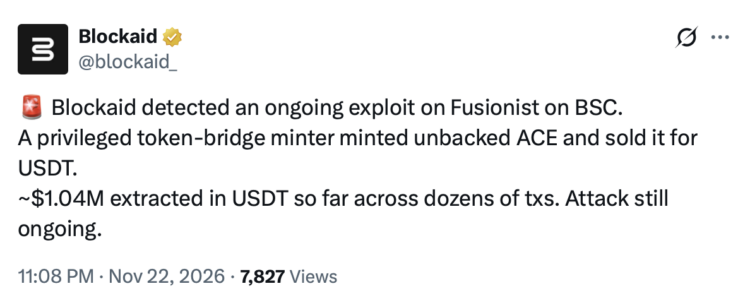
Blockaid flagged the Fusionist bridge-minter exploit on November 22 and described the mechanism: a privileged token-bridge minter minted unbacked ACE and sold it for USDT. Its interim estimate put extraction around $1.04 million while the attack was ongoing.
“
A privileged token-bridge minter minted unbacked ACE and sold it for USDT.
Blockaid · November 22 alert
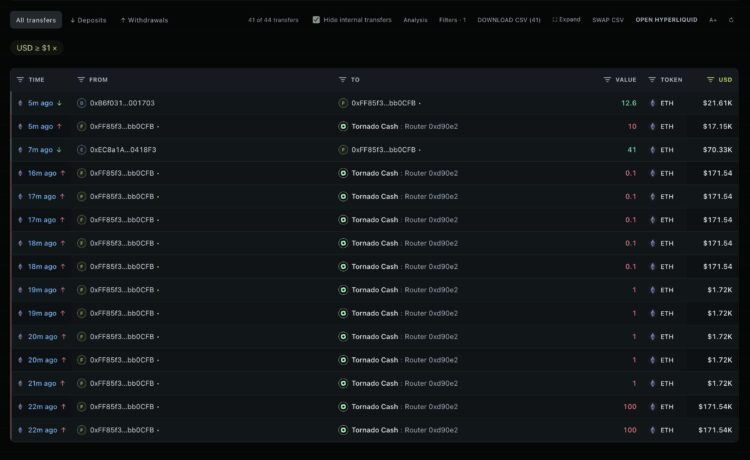
Onchain Lens reported that an attacker routed 1,091.5 ETH, valued at about $1.87 million at the time, through Tornado Cash. That figure tracks proceeds movement. It does not add to the initial extraction estimate. Fusionist acknowledged an ongoing ACE exploit on BNB Smart Chain and asked users to suspend transfers, trading and bridging on that network. It has not disclosed a reconciled loss total or a technical root cause identifying how privileged minting was abused.
A second drain via Endurance reserves
SlowMist’s incident entry states that traders bought discounted ACE on BNB Chain, then used the cross-chain bridge to withdraw approximately 53.7 million genuine ACE from Endurance reserves. The valuation at reference prices: about $3.7 million.
Mechanism: unauthorized supply on BNB Chain depressed the token price, while the bridge still honored those tokens for redemption into ACE on Endurance. The opportunity existed because the circulating representation and its backing diverged. The $3.7 million number values reserve outflows, not realized cash proceeds for recipients. Initiating the breach and trading a failed system are distinct actions.
Exchange impact: Bithumb halted ACE
Bithumb suspended ACE deposits and withdrawals on November 23, then halted trading at 7:30 a.m. Korea time, 2:30 a.m. in Dubai, citing indications that abnormally issued ACE had entered exchanges.
“
confirmed indications that abnormally issued ACE had entered cryptocurrency exchanges.
Bithumb · ACE security notice
The exchange pointed to two related BNB Chain transactions: transaction 1 and transaction 2. These are evidence leads. A full independent decoding of the transaction trail remains outstanding. Bithumb’s notice cites signs of abnormal supply rather than a finding that all customer ACE is invalid. The halt is a protective measure. Fungibility complicates remediation: exchanges and the issuer need a method to identify affected supply and set deposit and balance treatments.
Core failure and required disclosures
The key failure: the bridge honored claims from unbacked ACE, allowing redemption from real reserves. Technically valid transactions can still produce an economically harmful outcome when backing and representations diverge.
Disclosures needed: which minting permissions were affected and whether they were revoked, how much ACE was created without backing, how Endurance-side reserves changed, and what claims remain outstanding. Exchanges need a defensible token-treatment plan and clarity on any shortfall and responsibility for coverage.
SlowMist lists the cause as private-key leakage. That classification is not an official finding. Price movements during the incident and an unresolved compromise method add uncertainty, but they do not diminish the bridge-accounting failure.
The next milestone: a transparent reconciliation of tokens minted, reserves withdrawn and assets still available to back legitimate ACE claims. Until then, the $5.7 million estimate signals security and accounting risk in bridge designs.
Disclaimer: this article is for informational purposes only and is not financial advice.
Authors credited by the source: tomasrivas
Published by Holder based on an external source.