Bitso Business reaches $150B annualized stablecoin payment volume, up 83%
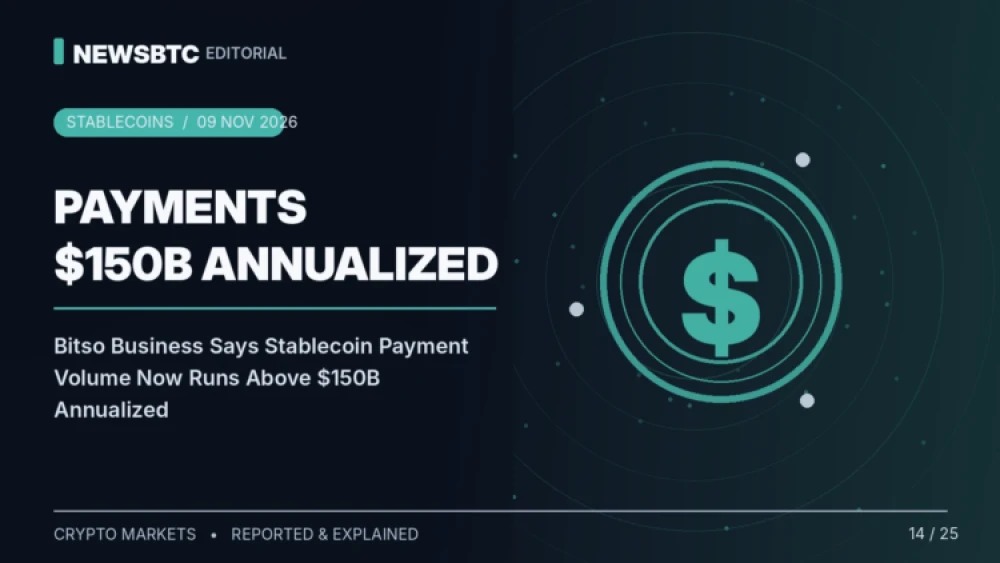
Bitso Business reports an annualized payment flow above $150 billion, up 83% from $82 billion a year earlier. The disclosure on November 4 highlights Latin American cross-border payments as a practical stablecoin use case. The figure is an annualized transaction run rate, not net revenue, assets under custody or an audited full-year settlement.
How to read the number
Bitso estimates a daily equivalent above $410 million and says more than 2,000 institutional clients use its infrastructure. Annualization converts a recent rate into a twelve-month equivalent, so the realized full-year total can change with activity. Payment volume measures funds passing through the system, potentially multiple times, rather than company earnings. This operating metric is company-provided and should be tracked across future periods for consistency.
Why stablecoins are involved
Cross-border transfers require movement across banking networks, currencies and operating hours. Stablecoin liquidity provides a route for value transfer between institutions that face cutoffs or slow intermediaries. Bitso’s model connects local payment systems to a round-the-clock settlement layer. End customers can remain in local currency while a service provider manages conversion and digital asset transfer in the background.
Where the economic benefit comes from
Key advantages: faster availability, predictable reconciliation and processing outside normal banking hours. Cost outcomes depend on exchange spreads, local partner fees, liquidity and compliance costs. Reliable offramps are necessary because payment utility often ends with a local bank balance rather than an onchain token. Stablecoins do not override capital controls or national payment laws, so regional partnerships and regulated access are critical.
Latin America’s specific demand
Remittances, business-to-business payments and cross-border commerce drive frequent currency conversion. Bitso cites remittance firms, neobanks, payments companies and digital commerce among its institutional users. These flows can be less speculative than price-driven crypto trading. Growth in total volume can reflect more customers, faster recycling of capital or foreign exchange shifts. The run rate does not reveal how many households benefited, average cost per transaction or country-level distribution.
What would demonstrate durable scale
Future disclosures should clarify transaction counts, recurring client retention, settlement costs and the share of payments completed within target times. Transparency about counterparty, issuer and local currency risks would improve comparability. Practical success is measured by reliable money movement rather than the number of tokens circulating on a specific chain.
Primary source: Bitso Business company announcement. Additional context: NewsBTC’s coverage of another consumer-facing stablecoin payment rollout.
Written by the News Desk and edited by Samuel Rae.
Authors credited by the source: NewsBTC Editorial Team
Published by Holder based on an external source.