Bitwise publishes 2031 SOL price scenarios: $80, $385, $1,100
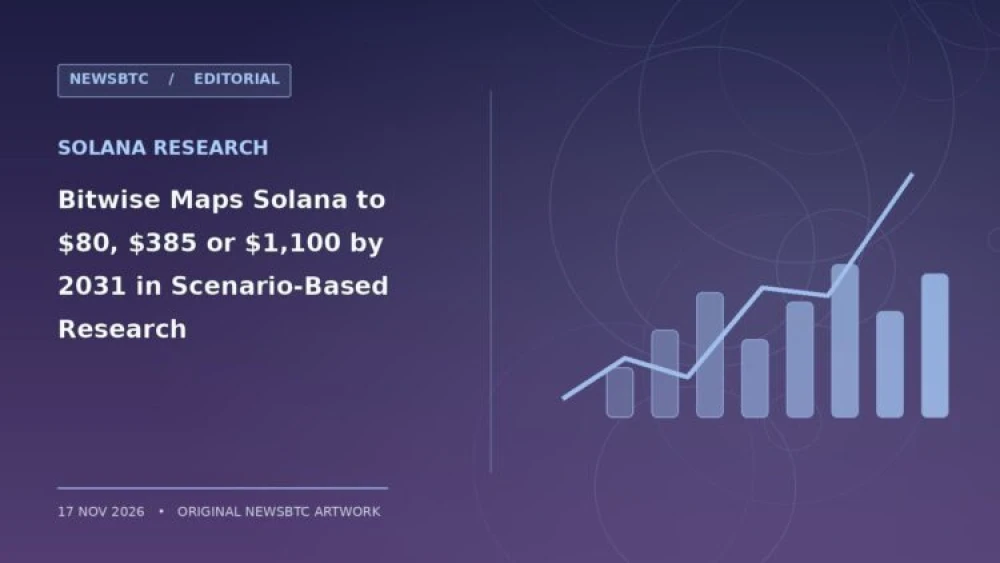
Bitwise’s latest research outlines a five-year framework for Solana with three conditional scenarios for 2031: an $80 bear case, a $385 base case and a $1,100 bull case. These are modeled outcomes tied to assumptions about tokenized assets, payments and 24/7 trading moving on-chain, not guarantees or price targets. The framework is intended to map how network activity could translate into SOL valuation, subject to execution, competition and market-structure risks.
What the research measures
The paper “Tokenization, 24/7 Trading, and the Economics of Solana” links SOL’s potential value to the role a fast blockchain could play in financial transactions: tokenized securities issuance and trading, on-chain payments and continuous markets. The publicly shared base-case figure is $385 for 2031. It represents a modeled result within a specific set of assumptions and disclosures, not a quoted forward price or a probability-weighted consensus. Comparing the figures with spot markets requires reviewing the inputs and risk factors.
The high case requires major market capture
The $1,100 scenario assumes significant tokenization and Solana dominance: 5% of global equities tokenized and a large share of the resulting trading volume processed on Solana. This illustrates upside sensitivity but raises execution risk. There is no assurance that issuers will tokenize at that pace or that Solana, rather than other blockchains or traditional infrastructures, will capture the majority of activity.
Related context: Solana treasury and staking disclosures.
Network growth does not automatically accrue to SOL
Even with growth in tokenized assets and payments, the link to SOL’s value depends on fee levels, demand for blockspace, token supply dynamics and competition. Low fees can attract activity without creating proportional token demand. Layer-two systems, private networks and alternative settlement rails may capture institutional flows. The pathway from network activity to token returns must be evaluated rather than assumed. Precise-looking forecast tables can mask uncertainty in business models.
How to use the scenarios
The scenarios are most useful for framing questions: how much volume tokenizes, how quickly payments migrate on-chain, what share Solana secures and what capacity is required. The bear case highlights that technology adoption and investor returns can diverge. Bitwise’s role as a crypto product issuer is relevant context when interpreting the framework. Treat each figure as conditional on its inputs, not as investment advice or an independent valuation fact.
Scenario analysis gains value when inputs are varied. Investors can test slower tokenization, tighter fee competition, different staking economics or lower valuation multiples than the base case. Small changes across assumptions can compound over five years. Outcomes depend on competitive dynamics, policy choices and technology shifts that may alter adoption paths.
Related context: Solana transaction-privacy development.
Key indicators to monitor: tokenized equity usage, on-chain payment volumes, transaction economics and competitive positioning. Tracking these over the next five years will show whether the thesis is strengthening or weakening.
Reporting sources: Bitwise research introduction · The Block scenario discussion
Written by the News Desk and edited by Samuel Rae.
Authors credited by the source: NewsBTC Editorial Team
Published by Holder based on an external source.