DRW Cumberland buys tokenized US stock on Canton under SEC innovation exemption
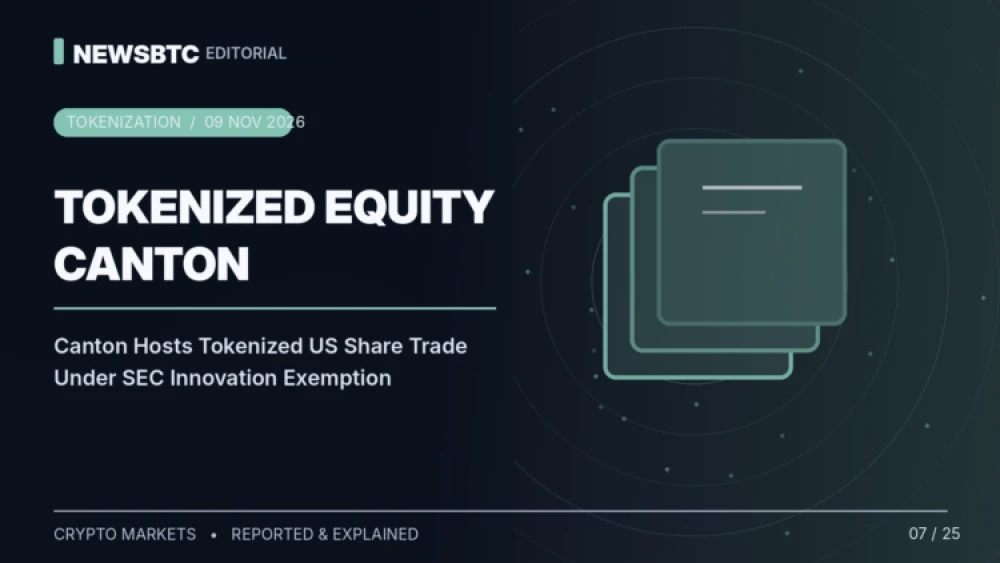
A tokenized share transaction for a Nasdaq-listed company took place on the Canton network under a US regulatory exemption. Venue operator TSV reported that on November 4, shares of Canton Strategic Holdings changed hands in a permissioned pool using Tradecraft’s automated market maker technology. The key development: the transaction was structured around the issuer, a transfer agent and verified holders, not a mere price mirror on a blockchain.
How the transaction was structured
TSV states that DRW Cumberland purchased tokenized Canton Strategic Holdings common stock from existing shareholder Five North. Fairmint, an SEC-registered transfer agent, recorded the shares in token form in a verified wallet. Flowdesk provided liquidity. The parties describe this as the first such trade under the SEC’s innovation exemption. That first-of-kind claim is attributable to the participants. Concrete elements include the named issuer, the identified parties, the permissioned venue and the transfer agent’s role in the official share record.
Why actual shareholder rights matter
Tokenized equities encompass different structures. Some provide economic exposure issued by an intermediary. Others aim to represent issuer shares with rights and recordkeeping aligned to conventional stock. In this case, issuer sponsorship and transfer-agent involvement are central. They aim to connect token holdings with the legally recognized ownership register. Investors still need clarity on transfer restrictions, voting rights, eligibility rules and corporate action administration. A blockchain token does not by itself prove those protections.
This is not open public share trading
The transactions occurred in a permissioned pool with verified participants. This differs from claims that any wallet can buy US shares without checks or via a decentralized exchange. Restricted access can be required to satisfy securities obligations, investor eligibility and transfer controls. It can also limit liquidity and interoperability relative to open token markets. The test is whether these controls operate at scale without making trading and settlement more cumbersome than conventional systems.
The regulatory context remains narrow
The transaction was conducted under the SEC’s innovation exemption announced in September. It should be interpreted within the conditions of that relief and not as evidence that tokenized securities are broadly deregulated. Different venues, issuers or instruments can require separate legal analysis. Reporting should distinguish among operational pilots, live limited transactions and broadly available retail markets. This case fits a live limited transaction with explicit participation boundaries.
What a meaningful follow-up looks like
Subsequent updates should detail the number and diversity of issuers, whether settlements are consistent, how ownership and voting are handled and whether positions transfer between approved venues. Costs, order-book depth and operational incidents will be more informative than first-trade headlines. If tokenized US equities mature into durable market structure, these operational metrics will be decisive.
Primary source: Tradecraft / TSV official announcement. Additional context: NewsBTC report on transfer agents supporting tokenized securities.
This article was written by the News Desk and edited by Samuel Rae.
Authors credited by the source: NewsBTC Editorial Team
Published by Holder based on an external source.