SEC staff won’t pursue enforcement for specified Canton Coin minting
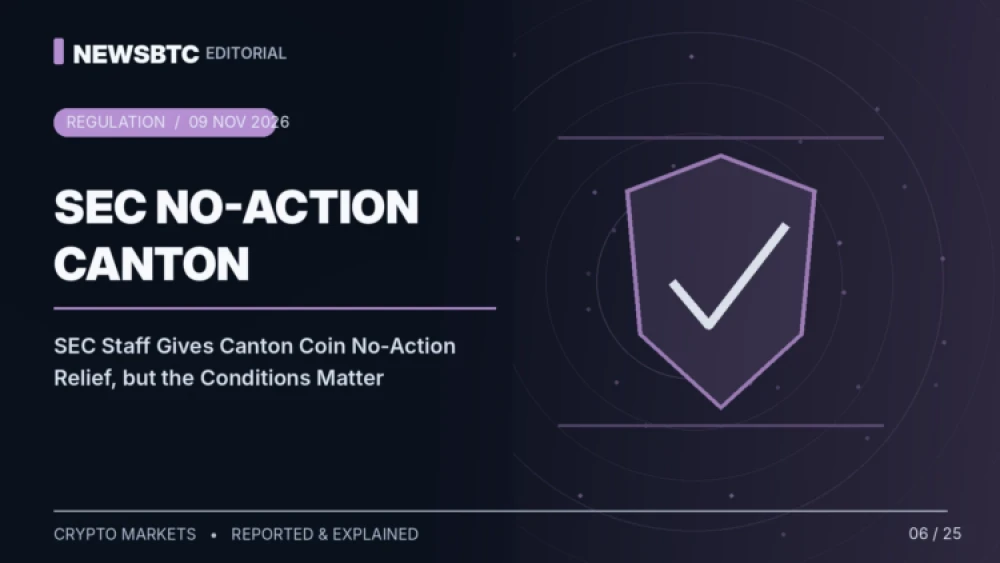
On November 3, SEC Division of Corporation Finance staff issued a no-action response stating that, based on the applicant’s representations, Canton Coin fits the Commission’s March 2026 interpretation of a digital commodity. The response covers specified minting activities and signals no staff recommendation of enforcement under cited Securities Act and Exchange Act provisions. The position is limited to the described facts and is not a court ruling or a Commission-wide legal declaration. It reduces uncertainty for certain Canton network activities, but it does not extend to all tokens, sales methods or financial products built on the network.
What the SEC staff actually said
Staff evaluated claims that the network lacks a central controlling party and that token value derives from programmatic network operation. The response addresses minting by super validators, validators and application providers under the described arrangements. On that factual basis, staff said it would not recommend enforcement for the specified minting without registration under the referenced Securities Act and Exchange Act provisions. The response is a staff enforcement posture, not a binding legal determination.
The facts supporting the answer are specific
The analysis relies on participants receiving tokens for operating infrastructure or providing applications, rather than expecting profits primarily from a central manager. It depends on the network being operational and decentralized as described. Staff cautioned that different facts could lead to a different outcome. A presale, centralized discretion or a different rewards model could change the analysis. Relief is tied to the presented activity and factual record.
Why institutions care about the distinction
Canton targets financial market use cases where operators need clarity to run validators and receive rewards. Ambiguous securities treatment affects procurement, legal review, custody and participation. The response removes one element of uncertainty for the described activities, but other obligations remain: broker-dealer, banking, sanctions, AML and derivatives rules may still apply based on how an institution uses the network. The letter does not approve every product on Canton or override separate laws governing securities and intermediaries.
A useful template, not a universal rule
The letter highlights which decentralization and utility features mattered to staff. Replicating terminology or validator labels will not replicate underlying facts. Teams should assess control, incentives, operational independence and launch history against the reasons cited by the agency. Timing matters: the March 2026 interpretation and the November staff response are parts of an evolving framework. Future rulemaking, litigation or legislation could alter the practical implications.
The next evidence to watch
Developers and investors should read the response alongside the underlying request, then monitor additional SEC guidance on digital commodities and token rewards. Track institutional participation, including custody arrangements and the distribution of validator control. Clearer rules can support experimentation, but they do not ensure token liquidity, network security or investment returns. The result is a fact-specific assurance for specified activities, not a broad license for tokenization.
Primary source: US SEC Division of Corporation Finance. For additional context, see NewsBTC’s coverage of the NYSE’s planned tokenized securities venue.
This article was written by the News Desk and edited by Samuel Rae.
Authors credited by the source: NewsBTC Editorial Team
Published by Holder based on an external source.