
CFTC lets trading venues count Bitcoin, Ether, stablecoins toward resources

CFTC staff issued guidance on November 23 that lets certain regulated venues count Bitcoin, Ether and qualifying payment stablecoins toward specific financial resource requirements with valuation haircuts. The advisory is nonbinding and excludes crypto from separate cash and liquid-resource obligations, which limits near-term buying pressure while expanding recognized utility for digital assets on institutional balance sheets.
- Swap execution facilities, designated contract markets and derivatives clearing organizations may include Bitcoin, Ether and qualifying payment stablecoins in financial resource calculations for operating costs.
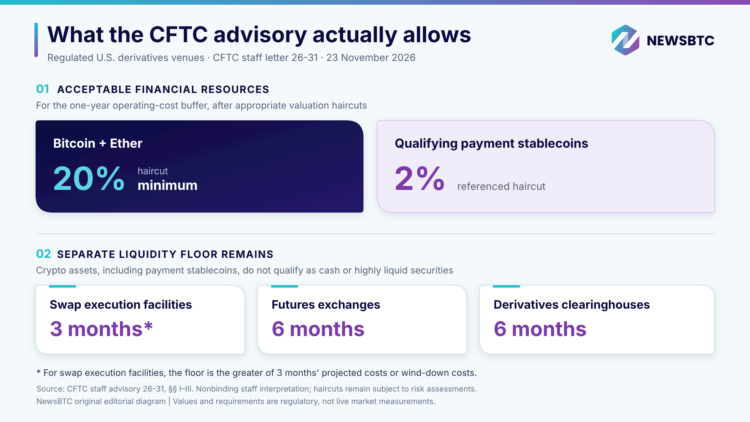
- Referenced haircuts: 20% minimum for Bitcoin and Ether; 2% for qualifying payment stablecoins; 100% for crypto assets that are not readily marketable or not qualifying payment stablecoins.
- Crypto cannot satisfy the separate cash and liquid-resources requirement: three months for swap execution facilities and generally six months for designated contract markets and clearinghouses.
- This is staff guidance, not a Commission rule: it does not require any institution to buy Bitcoin.
Scope of the CFTC Staff Advisory
The advisory applies to swap execution facilities, designated contract markets and derivatives clearing organizations. These venues must maintain resources to cover at least one year of operating costs. Under the guidance, Bitcoin, Ether and qualifying payment stablecoins may contribute to that requirement with appropriate valuation discounts. The guidance aligns with broader efforts to incorporate digital assets into regulated market infrastructure, including prior staff expectations for tokenized collateral at clearinghouses.
Haircuts and Valuation
Bitcoin and Ether: 20% minimum haircut. A $10 million Bitcoin reserve counts as $8 million toward eligible financial resources after the haircut. Qualifying payment stablecoins: 2% haircut. Non-qualifying or not readily marketable crypto assets: 100% haircut, which excludes them from the calculation. The haircut is a regulatory adjustment to reflect volatility risk rather than a realized loss.
CFTC staff highlights potential wrong-way risk
A prolonged crypto market decline can reduce trading revenues and the value of reserves at the same time.
Source: CFTC staff advisory
Distinction From Cash and Liquidity Requirements
Crypto assets cannot be used to meet cash and highly liquid resource requirements. Swap execution facilities must hold qualifying liquid resources for at least three months of projected operating expenses or wind-down costs, whichever is greater. Designated contract markets and clearinghouses generally must cover at least six months. The guidance does not address whether cryptocurrencies can satisfy separate default resources at clearinghouses. The CFTC recognizes Bitcoin as a contributory asset for institutional financial strength but does not grant it the same standing as cash.
Implications for Institutional Demand
The guidance increases the potential utility of existing Bitcoin and Ether holdings and reduces recognition uncertainty for institutions. It does not create an obligation or explicit incentive to acquire additional crypto, and institutions may prefer conventional securities due to haircuts and separate liquidity requirements. The advisory is not a binding rule. The key indicator of impact will be actual changes in reserve allocations by regulated venues.
Authors credited by the source: Andrei Belov
Published by Holder based on an external source.