
Microsoft declared Code Red to overhaul response after 24-hour outage

Microsoft reportedly launched a Code Red program after a 24-hour global outage on November 12-13. The event highlights how crypto services remain exposed to centralized infrastructure failures, even when blockchains continue operating.
Key takeaways
- Microsoft is overhauling engineering and incident response after the November 12-13 outage that lasted about 24 hours, according to internal memos reviewed by Reuters.
- Coinbase’s May outage was traced to a cooling failure in an AWS data center. All five matching engine nodes were in one building. Three went offline, there was no automated failover across availability zones, and AWS’s managed event-streaming issue complicated recovery. Trading, deposits and withdrawals were disrupted for about eight hours, with another 12 hours to restore remaining systems. An AWS outage in October 2025 had already caused three hours and 17 minutes of degraded performance.
- Moving assets off exchanges does not remove centralized dependencies. Wallets often rely on third-party RPC providers instead of user-operated nodes. If an RPC service goes down, balances and transactions can become inaccessible despite the blockchain operating normally.
- The central question is not whether crypto firms use cloud services but whether they have credible alternatives and tested failover paths when providers fail, especially as more assets move on-chain.
How a Cooling Failure Disrupted Coinbase
Coinbase’s June 1 incident report linked the May outage to a cooling failure inside an AWS data center. The exchange placed five matching engine nodes in the same building to meet latency and throughput requirements. Three nodes went offline, and the exchange lacked automated failover to another availability zone. An AWS managed event-streaming failure increased recovery time. Customers experienced severe disruptions for about eight hours, followed by roughly 12 hours to bring the rest of the systems back. Coinbase later committed to cross-zone recovery improvements and regular failover drills. The company previously reported three hours and 17 minutes of degraded performance during an AWS incident in October 2025. Coinbase and AWS have also partnered to bring x402 payments to CloudFront publishers, deepening cloud integration. The blockchain continued producing blocks during the disruption, yet customers could not access exchange services, which limited immediate use of on-chain settlement for assets custodied at the exchange.
“The duration of the outage is unacceptable to us,” Coinbase stated in its report.
Coinbase · June 1 incident report
Wallet Reliance on RPC Infrastructure
Ethereum wallets typically connect to the network through RPC endpoints to read chain data and submit signed transactions. Many users depend on third-party infrastructure rather than running their own nodes. If an RPC provider is unavailable, wallets may fail to display balances or broadcast transactions while Ethereum continues producing blocks. Ethereum documentation notes that concentrated cloud hosting can introduce a common point of failure.
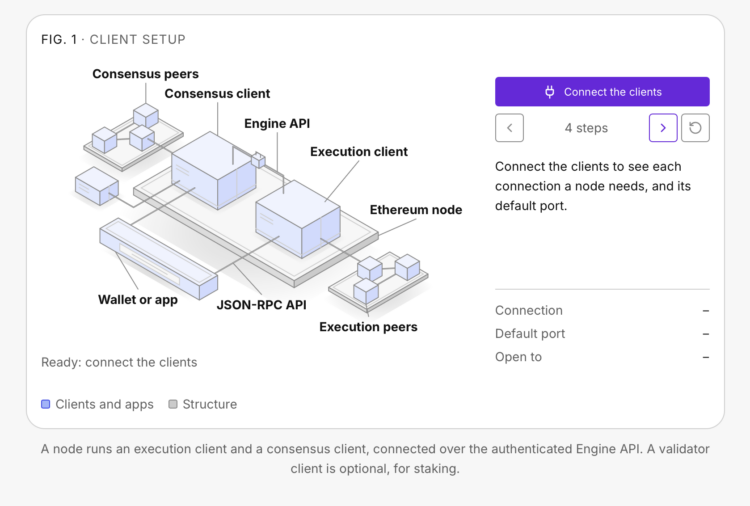
How a wallet app connects to Ethereum through an RPC connection.
Node distribution does not eliminate shared dependencies if many nodes run on the same hosting platforms. This concentration affects availability and security. The KelpDAO exploit reignited debates over verifier and RPC security, which differ from routine cloud outages but share infrastructure risk themes. Users can switch wallets to alternative RPC providers or run their own nodes. Developers can design multi-provider failover. These options are often hidden from typical mobile wallet users.
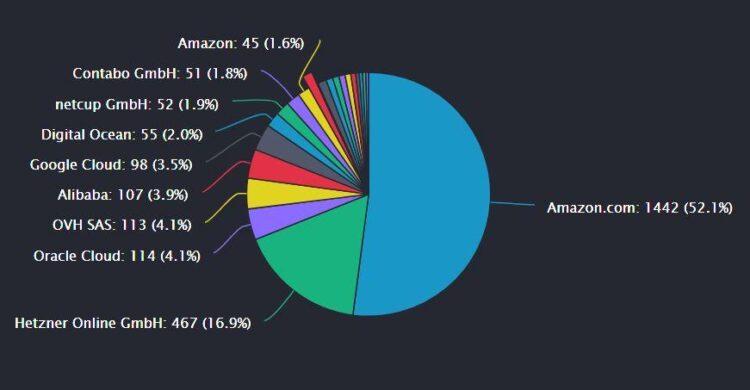
Distribution of Ethereum nodes.
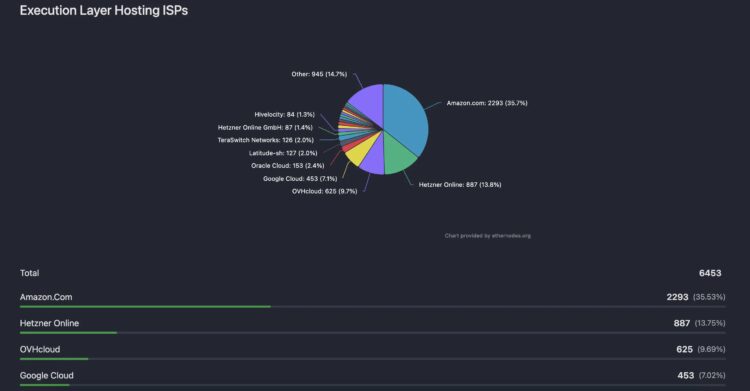
Hosting of Ethereum nodes across providers.
Centralization as an Engineering Tradeoff
Coinbase cited latency and capacity needs to justify co-locating matching engine nodes. Separating systems adds communication delay and increases synchronization costs for financial data. Cloud providers offer capabilities many crypto firms cannot reproduce alone. The issue is preparedness for provider failures. Coinbase outlined improvements for cross-zone recovery and production failover exercises. A published plan is not proof of successful execution during a surprise outage.
Implications of Microsoft’s Code Red
Reuters reported that Microsoft is reassessing prevention and response to major failures. The relevance for crypto lies in the connective infrastructure. As tokenized assets and on-chain markets expand, reliability of custody, banking ties, identity systems, RPCs, websites and middleware becomes critical. Decentralized exchanges can still be hindered by front-end outages or RPC issues. Firms should demonstrate operational continuity when a preferred provider goes offline: transaction submission, order cancellation and operator handover without manual engineering intervention. Microsoft’s response underscores that large-scale systems can harbor hidden weaknesses. Crypto does not need to abandon the cloud. It must avoid treating blockchain-level decentralization as proof that surrounding systems are resilient.
Authors credited by the source: Tomás Rivas
Published by Holder based on an external source.