PEPE whales accumulate over $21 million as single wallet tops 1% supply

PEPE whales currently hold more than six trillion tokens worth about $21.16 million, based on Lookonchain data. Most of this exposure sits in one wallet that has accumulated PEPE rapidly since November 17, while broader whale flows to exchanges indicate mixed positioning among large holders.
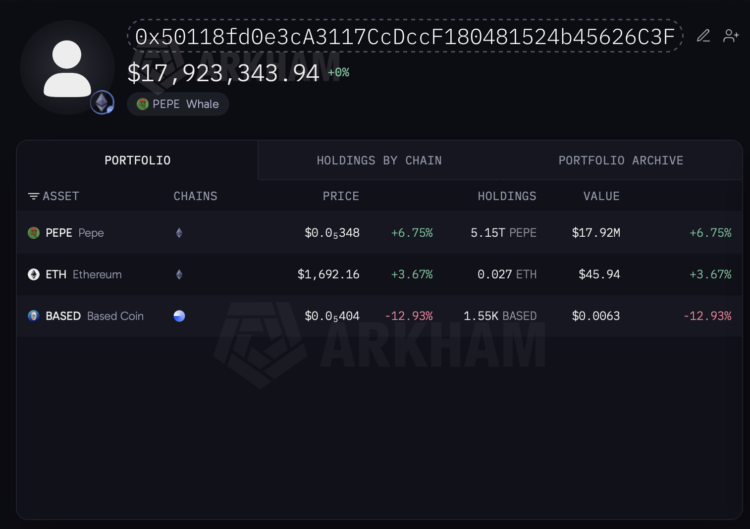
- On-chain data: PEPE whales hold more than six trillion tokens worth about $21.16 million. One wallet, 0x5011, has been accumulating since November 17 and now holds 5.15 trillion PEPE valued at roughly $18.28 million, around 1.22% of total supply. A second wallet, 0x6246, holds 868.16 billion PEPE, about $2.88 million.
- Accumulation dynamics: 0x5011’s position expanded quickly via Binance withdrawals. By November 19 it had withdrawn about 1.9 trillion PEPE, 2.878 trillion by November 23, more than 3.3 trillion by November 24, 4.16 trillion on Wednesday, and 5.15 trillion by Thursday.
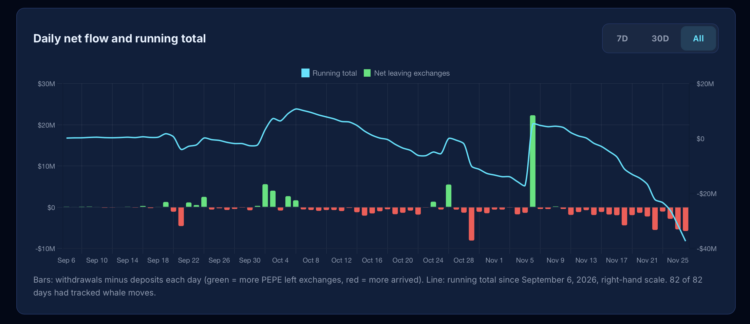
- Contrasting whale behavior: Deep Blue Alpha reports that, over the last seven days, withdrawals represented around 36% of tracked PEPE whale transfers between wallets and exchanges. Deposits to exchanges outweighed withdrawals, which indicates some large holders may be positioning to trade or de-risk while others accumulate.
- Interpretation limits: Exchange deposits do not prove imminent sales, and withdrawals do not confirm new spot buying. Centralized exchange trade execution and order books are not visible on-chain, so the ultimate direction of these flows remains uncertain.
- Position-risk profile: For a holder of 5.15 trillion PEPE, a price move of $0.000001 changes the position’s value by $5.15 million. Building an $18 million exposure is straightforward on-chain; exiting it at quoted prices depends on market liquidity, execution and the depth of bids across exchanges.
- Market structure impact: Concentrated holdings can reduce immediately available trading supply if tokens remain in cold wallets. If the same holdings move back to exchanges, they can increase perceived potential selling pressure. Monitoring whether these whales continue to accumulate or shift tokens to trading platforms is key for assessing future market impact.
PEPE’s current whale structure is defined by two unusually large addresses, led by 0x5011 with more than 1% of supply. At the same time, aggregate whale flows toward exchanges indicate that not all major holders share the same outlook. The balance between off-exchange accumulation and on-exchange positioning will influence future liquidity, volatility and potential price moves.
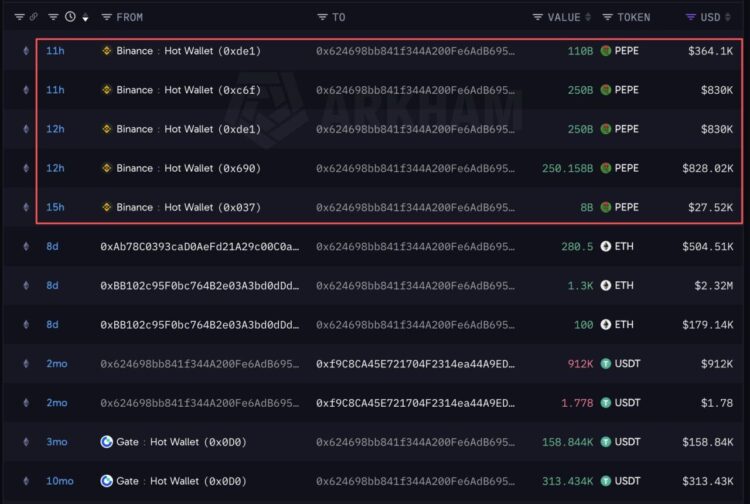
Concentration Of PEPE Supply In Whale Wallets
The 0x5011 wallet’s fast accumulation — reaching 5.15 trillion PEPE in eight days through large Binance withdrawals — creates a single-point concentration risk and a potential source of future liquidity shocks. The 0x6246 wallet’s 868.16 billion PEPE adds to this cluster, pushing combined tracked whale holdings above $21 million.
Exchange Flows And Whale Positioning
Deep Blue Alpha’s seven-day data indicates that only about 36% of monitored whale transfers were withdrawals from exchanges, while the majority were deposits. This pattern points to a mixed positioning environment: some whales removing PEPE to private custody or accumulating, others sending PEPE onto exchanges where it can be traded or sold.
Liquidity, Volatility And Exit Constraints
The scale of the 0x5011 position means that small price changes translate into multimillion-dollar swings, while the actual exit value depends on whether order books can absorb large sell volumes without significant slippage. Concentrated off-exchange holdings can tighten available supply and influence price formation; their return to exchanges can increase potential sell-side pressure. Observers will track whether these whale wallets continue to accumulate or start reallocating PEPE back to trading venues, as this behavior will shape future market conditions.
Authors credited by the source: Andrei Belov
Published by Holder based on an external source.