
Ethereum boosts Sepolia block gas limit to 200M in testnet
Ethereum’s Glamsterdam upgrade on the Sepolia testnet raised the block-gas limit from about 60 million to nearly 200 million. Activation occurred on Tuesday, October 6, with sampled blocks reported by Thursday, October 8. No mainnet activation date has been set.
What the Sepolia rollout tested
The upgrade evaluates how much additional block space Ethereum can provide while keeping larger blocks practical for validators and nodes. It includes changes to block production and validation, not just a higher gas limit. Nethermind reported following Glamsterdam on Sepolia with a beacon chain plugin that removes the need for a separate consensus client, bringing execution-layer proposer-builder separation and block-level access lists closer to mainnet.
Glamsterdam just went live on Sepolia, bringing ePBS and block-level access lists one step closer to mainnet.
This Nethermind node is following it with no separate consensus client, using a beacon chain plugin we're still developing. pic.twitter.com/gmFla5pzDo
— Nethermind (@Nethermind) October 6, 2026
Early block data on Sepolia
- Sampled blocks did not approach the new limit. More than half of nominal capacity remained unused, indicating headroom rather than sustained demand at the new ceiling.
- The gas limit increase does not linearly translate to transaction counts. Glamsterdam changes gas costs for specific operations, so transaction throughput depends on transaction composition.
- Consensus performance in a separate six-minute period: all 32 scheduled blocks were produced, and 99.97% of eligible stake voted toward finality. This observation is separate from the block-usage sample and does not imply those blocks were near capacity.
Capacity, costs, and node requirements
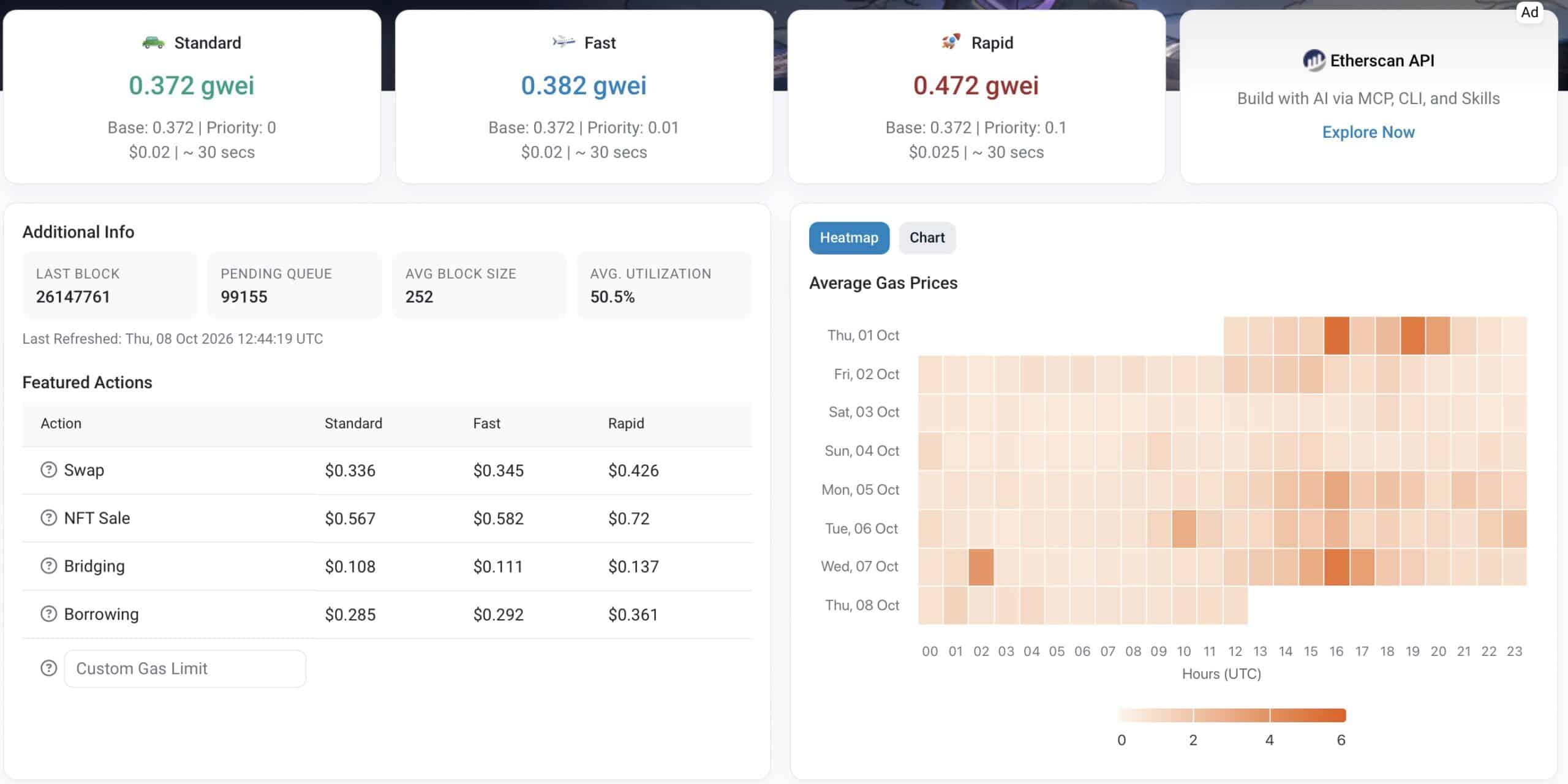
Ethereum Gas Etherescan
- Higher activity increases demands on node hardware, especially if blocks regularly near the larger allowance.
- Glamsterdam adjusts charges for creating and accessing stored data, linking block capacity tests to state growth management. Developers were instructed to retest applications sensitive to specific gas costs.
- Ethereum’s roadmap frames these changes as scaling measures designed to preserve manageable hardware requirements and broad validator participation. Network-wide activity provides context for why larger limits have not yet produced consistently full blocks.
Next milestones
- Hoodi testnet activation is tentatively planned for October 27, contingent on Sepolia results.
- No mainnet activation date for Glamsterdam has been announced.
Authors credited by the source: Daniel Francis
Published by Holder based on an external source.