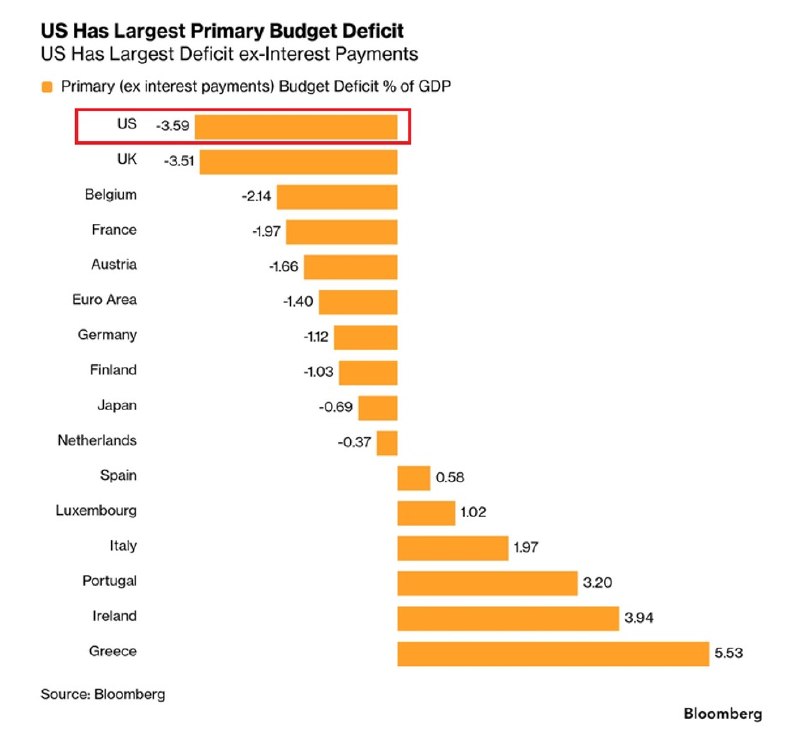
US records largest primary deficit at 3.59% of GDP among peers
The US primary budget deficit: scale and global comparison
The United States is running a primary budget deficit of -3.59% of GDP. Primary deficit excludes interest payments on existing government debt, which exceed $1.1 trillion annually and rank as the second-largest federal outlay, larger than defense. Among major advanced economies, the US primary deficit is the largest relative to GDP.
Global peers:
- United Kingdom: -3.51% of GDP
- Belgium: -2.14%
- France: -1.97%
- Austria: -1.66%
- Euro Area aggregate: -1.40%
Implications:
- The US fiscal position is the weakest among major advanced economies on a primary basis. This indicates structural imbalance that persists even before accounting for interest costs.
- Interest costs amplify total deficits beyond the primary gap, given the current rate environment and debt stock.
- Elevated and widening deficits increase Treasury supply needs, which can pressure yields upward and tighten financial conditions.
- For crypto and risk assets: rising yields and fiscal concerns historically correlate with risk-off episodes and dollar strength, both negative for crypto prices. However, if fiscal stress prompts policy responses that weaken the dollar or re-ignite liquidity injections, the impact could shift.
Key takeaway: The US runs the largest primary deficit among advanced economies despite excluding interest expenses, signaling fiscal deterioration that tends to be bearish for risk assets, including crypto, in the near term.
Authors credited by the source: thekobeissiletter
Published by Holder based on an external source.