
Vitalik Buterin urges open chip designs to strengthen crypto wallet security

Key takeaways
- Vitalik Buterin’s November 26 essay argues that crypto security must also cover the physical chips inside devices, summarized as “Not your silicon, not your keys.”
- He proposes that manufacturers publish physical chip layouts GDS files so investigators can compare deployed hardware with the intended design.
- Andrew Huang’s Infra-Red, In Situ inspection IRIS can examine chips without desoldering, but resolution limits prevent full verification of modern, dense silicon.
- Buterin’s essay is a security proposal, not evidence of compromised hardware wallets, and does not grant him unilateral authority over Ethereum.
- Arkham attributes roughly $390 million in tracked assets to Buterin, including about 224,000 ETH, but his full net worth remains unknown.
Vitalik Buterin, Ethereum’s co-founder, is questioning the security of the hardware that crypto users rely on to protect their assets. The 32-year-old programmer is focusing on risks that software transparency alone cannot mitigate: compromised computer chips.
In a November 26 essay, Buterin argued that cryptocurrency security must include hardware, not only the software stack. He framed this extension of the crypto self-custody principle with a hardware-focused line:
“
Not your silicon, not your keys.
Vitalik Buterin · Essay, November 26
Challenging trust in hardware manufacturers aligns with Buterin’s broader focus on independently verifiable infrastructure. This includes his work on privacy and quantum safety on Ethereum and his interest in verifiable computation.
Who Is Vitalik Buterin?
Vitalik Buterin is a Russian-Canadian programmer, researcher and writer who proposed Ethereum in 2013 at age 19.
Born in Russia in 1994 and raised in Canada, Buterin encountered Bitcoin in 2011. He later co-founded Bitcoin Magazine and analyzed cryptocurrency technology and economics before large financial institutions entered the sector.
Working with Bitcoin exposed limits in building complex applications on its base layer. Buterin concluded that a new blockchain focused on programmability would be more suitable than extending Bitcoin for every use case.
During this period he studied computer science at the University of Waterloo and worked as a research assistant to cryptographer Ian Goldberg.
According to the University of Waterloo, Buterin received a $100,000 Thiel Fellowship in 2014 and left university to focus on Ethereum.
How Vitalik Buterin Created Ethereum
In November 2013, Buterin drafted the original Ethereum whitepaper.
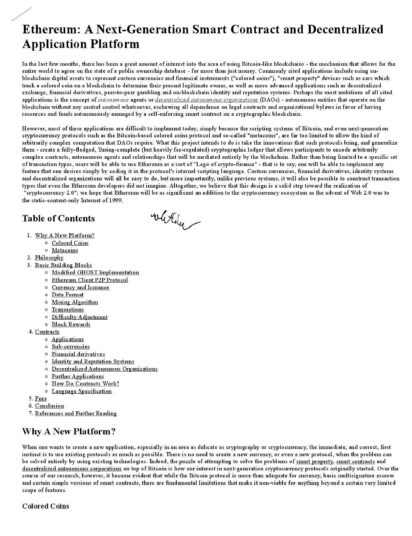
The whitepaper proposed a blockchain with a general-purpose programming environment. Developers could deploy decentralized applications without creating a new chain for each project.
On Ethereum, a lending protocol’s logic such as collateral rules, interest calculation and withdrawal conditions can be encoded in smart contracts that execute on a shared blockchain.
Smart contracts still face risks such as coding errors, unreliable external data sources and centralized admin controls. Ethereum’s contribution is a platform where such contracts run with shared state and transparent execution.
Ethereum was developed by a founding team including Buterin and seven other contributors: Gavin Wood, Joseph Lubin, Charles Hoskinson, Anthony Di Iorio, Mihai Alisie, Jeffrey Wilcke and Amir Chetrit.
The first live network, Frontier, launched on July 30, 2015.
Ethereum has since become core infrastructure for decentralized finance. Stablecoins, decentralized exchanges, lending protocols and tokenized assets frequently operate on its base layer or connected networks.
The transition from proof-of-work to proof-of-stake and the development of Layer 2 scaling solutions have shaped Ethereum’s first decade.
Vitalik Buterin’s Latest Warning: Can Crypto Wallets Really Be Trusted?
Hardware wallets isolate private keys from general-purpose devices to reduce exposure to malware. Buterin’s essay asks what happens if the hardware wallet itself is untrustworthy.
He highlights supply chain attacks that involve tampered wallets and examines how malicious changes could be embedded inside chips that appear legitimate externally.
Open-source firmware lets security researchers audit device instructions. However, firmware transparency does not guarantee that the physical chip matches the expected design.
Buterin proposes that manufacturers publish chip layouts GDS files. This would provide reference designs that specialist investigators could compare against the physical silicon in deployed devices.
He emphasizes that a chip’s specified behavior and the behavior of the actual manufactured part are distinct, and the difference is relevant for key custody.
The Technology That Could Help Detect Compromised Chips
Buterin references work by hardware security researcher Andrew Huang, also known as bunnie, who is developing Infra-Red, In Situ inspection IRIS.
IRIS uses the property that silicon becomes transparent at certain infrared wavelengths. With infrared light and appropriate imaging systems, researchers can inspect elements of a chip’s internal structure without removing it from the circuit board.
This approach can reveal substituted components or unexpected deviations between fabricated silicon and its published design.
IRIS has constraints. In a 2024 update, Huang explained that infrared imaging cannot capture all microscopic features of modern chips. Integrating imaging with electrical testing can improve confidence but not guarantee exhaustive verification.
For crypto users, open hardware designs and inspection tools reduce certain risks but do not replace comprehensive security analysis. Publishing a design is similar to publishing a smart contract: the artifact remains subject to vulnerabilities and implementation flaws.
Buterin notes that detailed chip inspection is likely to be performed by specialist labs or organizations, not retail wallet owners.
His essay sets out options to improve hardware trustworthiness and explicitly states that it is not evidence of widespread compromise in existing hardware wallets.
Does Vitalik Buterin Control Ethereum?
Buterin is a highly visible co-founder of Ethereum but does not hold a CEO role over the network.
Ethereum operates through decentralized participation by independent developers, researchers, node operators, validators and other contributors. Network changes follow a process of proposals, discussion, client implementation and voluntary adoption.
Buterin’s views carry significant weight but do not grant him unilateral control over protocol upgrades or ecosystem decisions.
His position in the Ethereum Foundation is advisory. In an April 2025 governance announcement, the Foundation defined his responsibilities as providing technical and intellectual guidance to the ecosystem.
His research influences debate around Ethereum’s future direction, but implementation depends on coordination across many independent stakeholders.
How Much Is Vitalik Buterin Worth?
Buterin’s wealth is closely linked to Ethereum and related holdings, with publicly visible assets dominated by ETH positions.
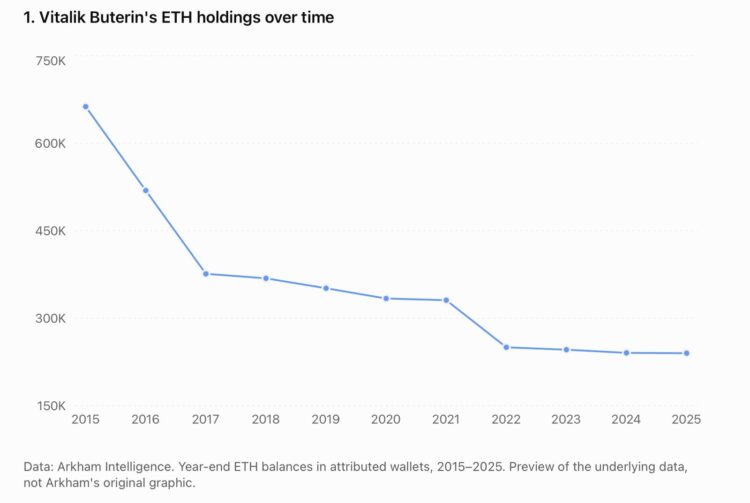
His total net worth is not definitively known, as only part of his assets are linked to public blockchain addresses or disclosed holdings.
Analytics platforms can estimate the value of on-chain assets attributed to him via known wallets. These figures exclude non-crypto investments, liabilities, private assets and potential undisclosed addresses.
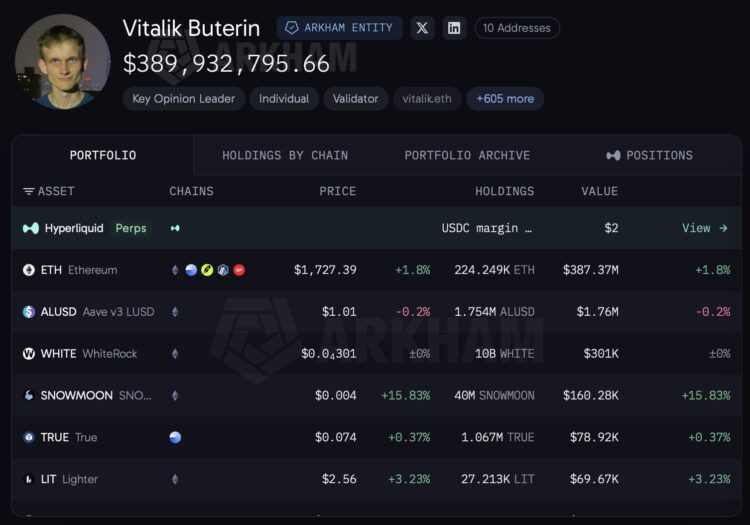
Arkham Intelligence shows about $389.9 million in tracked assets, including 224,249 ETH, for wallets it attributes to Buterin. These valuations change with market prices and do not represent a full balance sheet view of his finances.
What Is Vitalik Buterin’s Vision for the Future of Crypto?
Buterin’s recent essay extends his interest in full-stack openness and verifiability into semiconductor design and wallet hardware.
In September 2025 he published The Importance of Full-Stack Openness and Verifiability, addressing how transparency across both hardware and software could support trustworthy digital infrastructure.
His research spans cryptography, privacy, scalability and quantum resistance for Ethereum. He has argued for greater experimentation at the application layer while retaining censorship resistance, open-source development, privacy and security as core values.
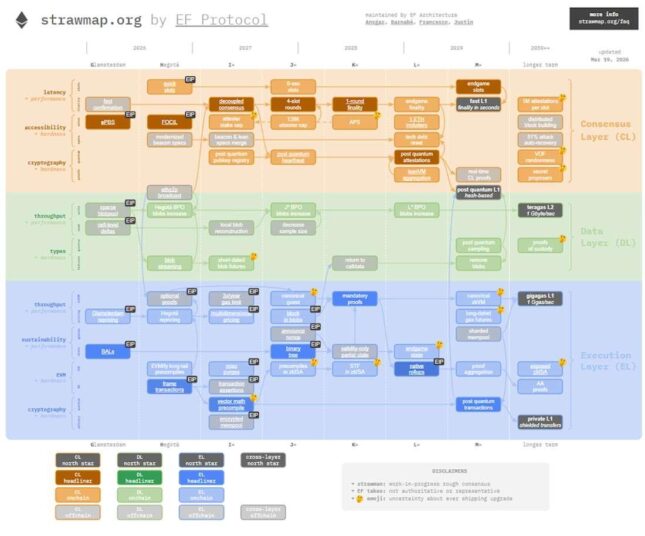
A central concern in this work is whether users can independently determine that their tools and infrastructure behave according to published rules.
He notes commercial barriers to open chip design. Semiconductor companies depend on proprietary fabrication processes, and designing chips for inspectability can affect performance and cost.
Wallet hardware used to sign transactions does not require the throughput of high-end AI accelerators. This opens space for security-focused silicon that trades peak performance for verifiability and robust supply chain integrity.
More than ten years ago, Buterin expanded blockchain use cases beyond simple payments. His current work challenges the assumption that verifying software code is sufficient, arguing that hardware must also be open to inspection and verification.
For crypto investors, significant progress in security may depend on hardware manufacturers adopting inspectable, open designs and enabling third-party verification, as much as on new software or protocol-level upgrades.
Authors credited by the source: Tomás Rivas
Published by Holder based on an external source.