
World Liberty Financial sells $20M Ethereum, shifts into USDC and USD1

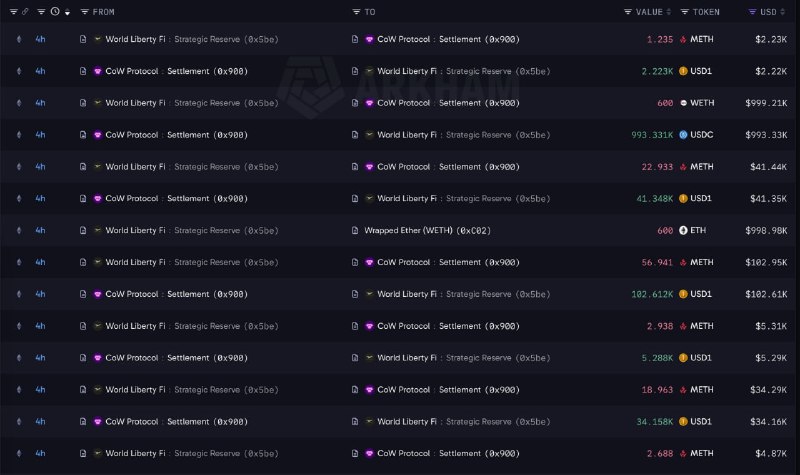
- A wallet linked to World Liberty Financial sold 10,600 WETH and 1,378 mETH for about $20.06 million.
- Proceeds were converted into about $17.58 million USDC and $2.48 million USD1, the project’s stablecoin.
- On-chain analyst Ember estimates an average ETH acquisition cost of $3,244 against a disposal value near $1,655, implying an unrealized loss of about $19.26 million on this wallet’s positions.
- The loss figure is an on-chain cost-basis estimate, not audited, and applies only to the analyzed wallet rather than all project holdings.
- The sale reverses earlier Ethereum accumulation, and there is no verified evidence that Donald Trump personally directed these trades.
Trump-backed World Liberty Financial has reduced Ethereum exposure by about $20 million, shifting two large holdings into dollar-pegged stablecoins during a market downturn in cryptocurrencies.
Lookonchain reported that a project-linked wallet sold 10,600 ETH and 1,378 mETH, receiving about $20.06 million. Separate analysis by Ember indicates the sale likely crystallized a substantial loss relative to the estimated acquisition cost.
These transactions follow World Liberty Financial’s announcement of a WLFI governance token buyback program, potentially funded by yield from USD1 stablecoin reserves. The recent Ethereum disposals mark a shift away from a previous strategy of accumulating ETH during weaker market phases and highlight a move toward stablecoin-denominated positions.
Shift Into USDC And USD1
The wallet received about $17.58 million in USDC and $2.48 million in USD1, World Liberty Financial’s dollar-linked stablecoin. Arkham data shows transfers between the project’s labeled Strategic Reserve wallet and CoW Protocol, with mETH sent out and USD1 received, and additional interaction with the Dolomite lending protocol.
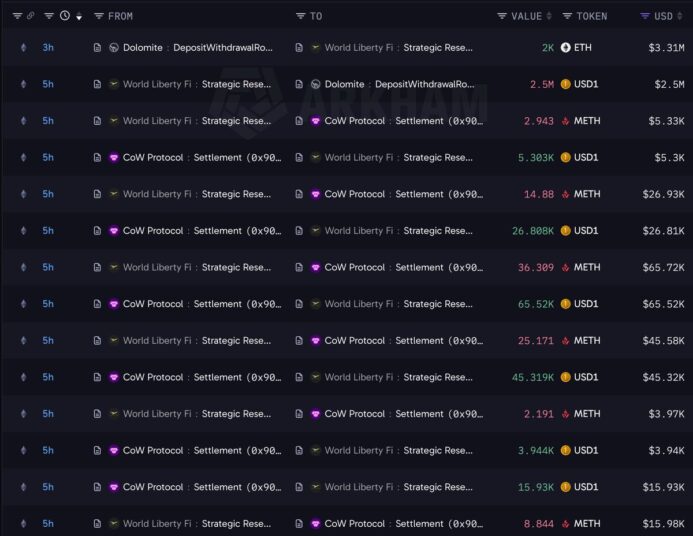
The assets sold included WETH and mETH. mETH represents staked ETH exposure and does not always trade at a one-to-one ratio with ETH, so simply adding token counts can misstate underlying ETH value. Ember’s assessment is that the combined WETH and mETH positions equated to about 12,121 ETH exposure.
Ember estimated an average purchase price of $3,244 per ETH and an average sale price near $1,655. On that basis, the transactions imply a loss of around $19.26 million, about 49% of the estimated original cost. These values are derived from on-chain activity, not from audited accounts or official project disclosures.
| Transaction | Reported figure |
|---|---|
| Sold | 10,600 WETH + 1,378 mETH |
| Ethereum-equivalent exposure | ≈12,121 ETH |
| Received | $17.58M USDC + $2.48M USD1 = $20.06M |
| Estimated average cost | $3,244 per ETH (≈$39.3M) |
| Average disposal value | ≈$1,655 per ETH |
| Estimated loss | ≈$19.26M (about 49%) |
Cost basis and loss are on-chain estimates, not audited results. Data: Lookonchain, Ember. Visualization: NewsBTC.
World Liberty Financial has not publicly confirmed this loss figure in formal financial reporting, so it remains an inference based on blockchain data rather than a certified accounting statement.
USD1, Revenue, And Incentive Alignment
Allocating part of the proceeds into USD1 highlights the project’s stablecoin as a revenue-linked instrument. World Liberty Financial’s USD1 risk disclosures state that World Liberty Financial and BitGo benefit from net fees generated by interest on USD1 reserves. USD1 holders do not receive those reserve earnings, which establishes a divergence between the economic interests of issuers and holders.
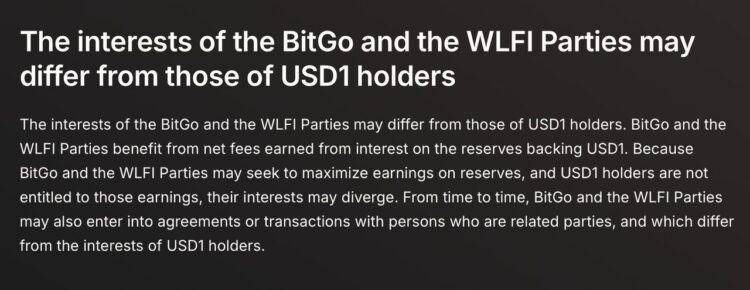
This means USD1 is integral to World Liberty Financial’s business model as a yield-generating digital dollar product, not only a treasury asset. However, holding USD1 within a project-controlled wallet does not itself produce extra returns for that wallet beyond any aggregate reserve yield, and swapping previously held tokens into USD1 does not automatically expand circulating supply or reserve income.
The key issue is whether these moves indicate short-term treasury positioning during volatility or a structural shift away from Ethereum and toward dollar-linked and self-issued assets.
Reversing Earlier Ethereum Accumulation
In January, World Liberty Financial reportedly acquired about 2,868 ETH funded by the sale of more than $8 million in wrapped Bitcoin. The November activity goes in the reverse direction: the analyzed wallet reduced Ethereum-related holdings in favor of USDC and USD1. This does not establish that the broader project has exited Ethereum entirely, as the analysis is limited to a labeled Strategic Reserve wallet and connected addresses.
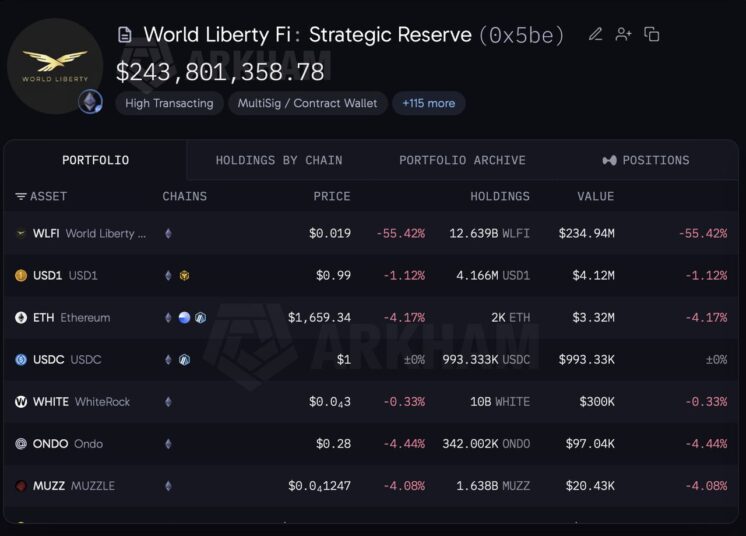
Arkham Intelligence data shows that on November 28 the Strategic Reserve wallet held about $243.8 million in digital assets, with more than 96% of that value from WLFI tokens. The wallet still held 2,000 ETH, worth about $3.32 million at the time. This concentration in WLFI implies that headline portfolio value is highly sensitive to the market price of the project’s own token and does not equate directly to liquid reserves.
There is no verified evidence that Donald Trump personally authorized or instructed these transactions. The on-chain record establishes asset movement but not internal decision-making processes or signatory details.
For Ethereum market participants, this sale illustrates another large entity reducing ETH exposure under stress conditions, which can signal risk aversion and pressure on prices. For World Liberty Financial stakeholders, the more significant issues are the project’s treasury allocation choices, approach to managing investment drawdowns, reliance on its own token and stablecoin, and the level of transparency in explaining these moves beyond what can be inferred from public blockchain data.
The blockchain shows where the assets went and when. It does not reveal who made the strategic decisions or the rationale behind them.
Authors credited by the source: Elena Marquez
Published by Holder based on an external source.