

Bitcoin whales boost holdings by 121,117 BTC despite 29% price drop

Key takeaways
- Balances in Bitcoin addresses holding 1,000 to 10,000 BTC rose by 121,117 BTC from September 30 to November 21, worth about $7.4 billion at a reference price of $61,000, while Bitcoin fell 29.5% over the same period.
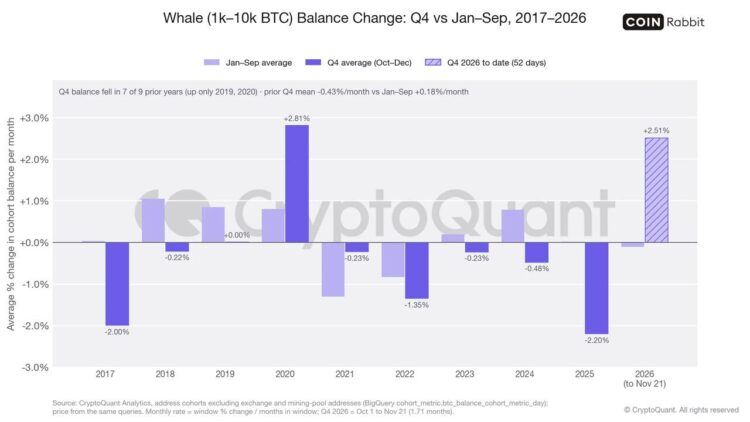
- This cohort reduced holdings in seven of the previous nine fourth quarters. Its 4.29% balance increase so far in Q4 2026 is the largest fourth-quarter rise since 2020.
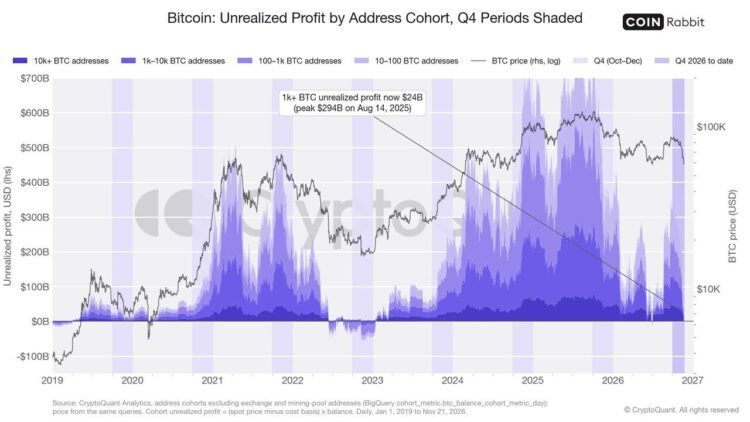
- The group’s unrealized profit margin fell from 33.9% to 5.7% by November 21, the lowest level in 2026 in the report.
- Addresses holding at least 1,000 BTC recorded about $2.1 billion in net realized losses through November 21. Exchange inflows from transaction outputs of at least 1,000 BTC increased in November.
- Rising address balances alone do not show how much new capital entered Bitcoin or whether the price has reached a bottom.
Bitcoin whales have reversed their usual year-end pattern. Between September 30 and November 21, balances in addresses holding 1,000 to 10,000 BTC rose by 121,117 BTC while Bitcoin lost 29.5% of its value. At a reference price of $61,000, the additional coins are worth roughly $7.4 billion.
The data comes from CryptoQuant’s November 27 research report, supported by crypto lender CoinRabbit. The study excludes exchange and mining-pool addresses from its cohorts and provides a snapshot through November 21 rather than a full-quarter outcome.
Timing intersects with recent fund flows. NewsBTC reported more than $2 billion in US spot Bitcoin ETF outflows. ETF withdrawals and rising whale balances reflect different segments. The data does not show whether investors are reallocating from ETFs into direct Bitcoin ownership.
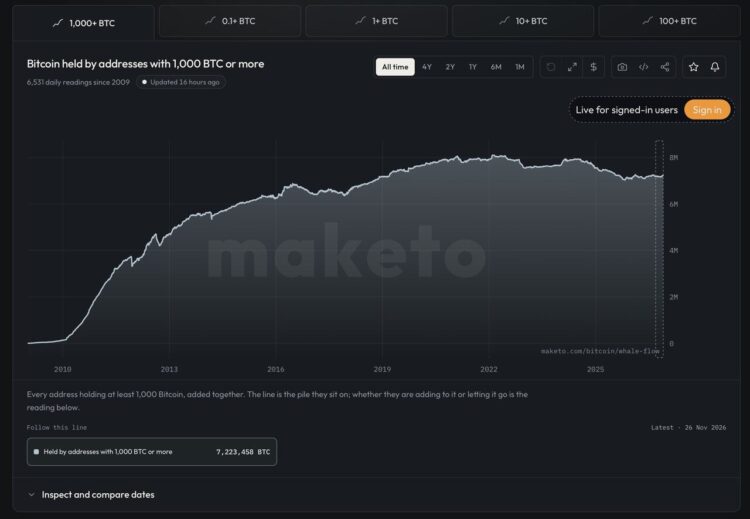
Maketo’s broader whale holdings data shows addresses with at least 1,000 BTC holding 7.22 million BTC on November 26, up 54,379 BTC over the preceding 30 days. This series includes exchange and custody addresses and indicates where coins are held rather than confirming CryptoQuant’s 121,117 BTC cohort increase.
Bitcoin Whales Reverse Their Year-End Balance Trend
The combined balance of the 1,000 to 10,000 BTC cohort stood just under 2.95 million BTC on November 21, up from 2.83 million BTC at the end of September.
Large addresses reduced balances in seven of the nine preceding fourth quarters. Only 2019 and 2020 differed from that pattern. The 4.29% increase recorded so far in Q4 2026 is the largest Q4 gain since 2020, though December data could change the outcome.
In Q4 2025, the cohort’s balance dropped by nearly 203,000 BTC. The current rise has occurred during a declining market rather than a price rally.
The $7.4 billion figure is based on valuing the additional coins at a reference price. It does not represent the amount of dollars spent acquiring those coins. On-chain transfers between addresses, and movements across cohort thresholds, can alter the measured total without new market purchases.
The balance increase identifies where Bitcoin currently resides, not the volume of fresh capital supporting it. This distinction is important in low-liquidity conditions.
Bitcoin Whales Are Running Out Of Profits To Protect
The 121,117 BTC balance growth signals accumulation, but the remaining unrealized profit margin indicates how much cushion large holders still have.
For addresses holding between 1,000 and 10,000 BTC, the unrealized profit margin fell from 33.9% at the end of September to 5.7% on November 21, the lowest reading of 2026 in the report.
In dollar terms, combined unrealized profits for addresses with at least 1,000 BTC dropped to about $24 billion on November 21 from a peak of $294 billion in August 2025.
Across all addresses holding at least 1,000 BTC, net realized losses reached about $2.1 billion in the first 52 days of Q4. On-chain data indicates that some large holders are moving coins at a loss instead of waiting for a rebound.
The key difference is between balances as of a given date and the profit or loss on coins that actually move. A rising total balance does not prevent other coins within the same cohort from being spent below their estimated cost basis.
Exchange deposits offer another angle. Inflows from unspent transaction outputs of at least 1,000 BTC averaged 5,012 BTC per day in November through the cutoff date, up from 3,239 BTC in October. This metric captures large transaction outputs, not a count of distinct whales.
Quarter-to-date, the average of 3,955 BTC per day remained below the 2019–2025 Q4 average of 4,575 BTC. Large deposits can precede sales but do not prove that selling has occurred or intensified.
What Would Confirm A Bitcoin Market Bottom?
The 2018 and 2022 bear markets offer comparison points but do not provide a direct roadmap for the current cycle.
Balances in the 1,000 to 10,000 BTC cohort fell in both of those earlier fourth quarters, and their average unrealized profit margins were negative. In Q4 2026 up to November 21, the cohort still shows a positive margin.
The current accumulation suggests that some large holders are maintaining or increasing exposure during the downturn. Address-level data does not reveal motivations or isolate how much of the increase came from new purchases versus internal transfers.
These indicators alone do not confirm a market bottom.
Further price declines could remove the cohort’s remaining profit cushion. Potential forced or discretionary selling would depend on holders’ liquidity needs and positioning, which are not directly observable from address balances.
A stronger recovery signal would include continued growth in large-address balances, a decline in net realized losses, moderation in large exchange deposits, and independent evidence of renewed spot demand.
The change in year-end positioning among CryptoQuant’s measured cohort is clear. Evidence of a durable recovery trend has not yet appeared.
Authors credited by the source: Andrei Belov
Published by Holder based on an external source.