
Polymarket traders price Bolsonaro at 84.8% to win runoff
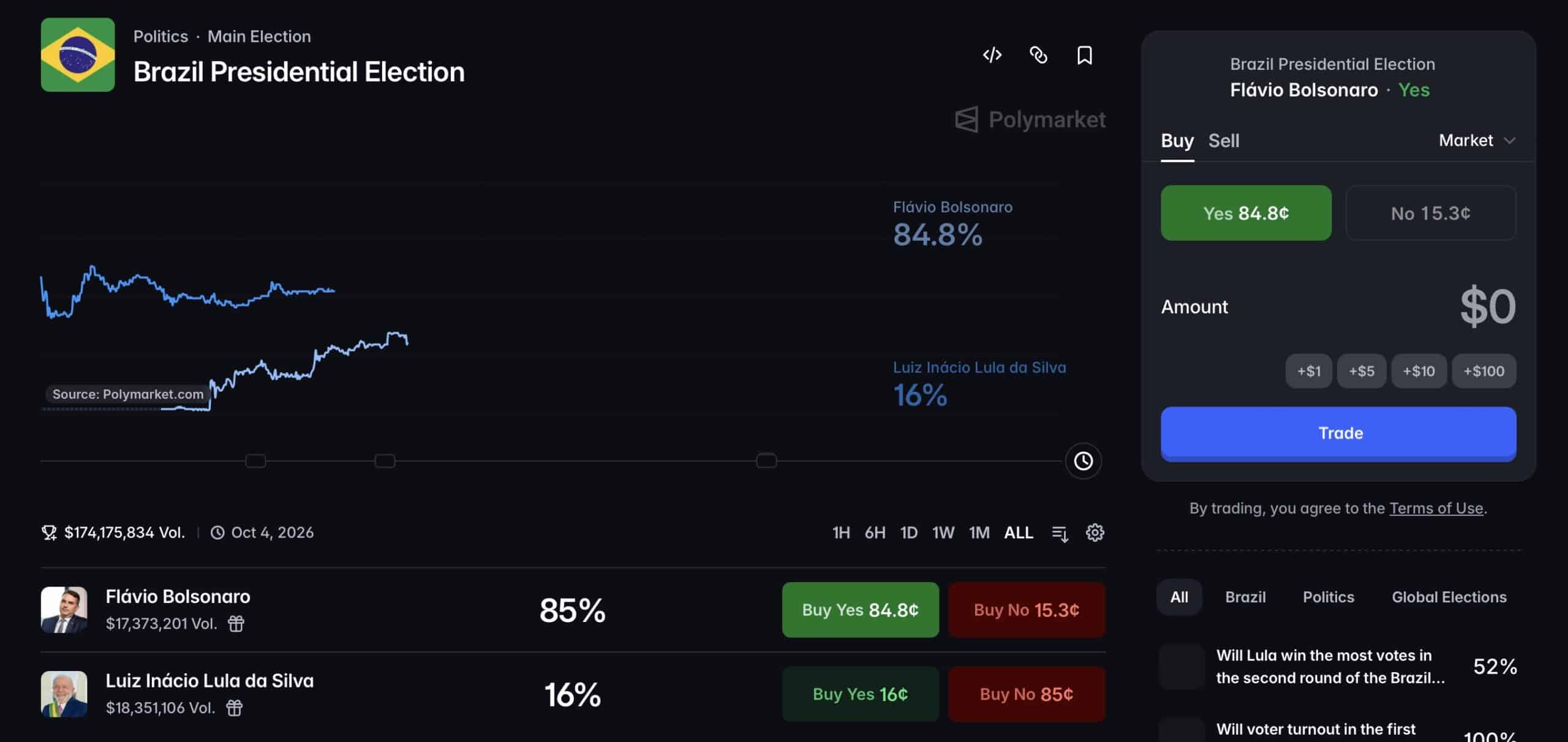
Polymarket traders currently price Flávio Bolsonaro’s chances of winning Brazil’s presidency at 84.8% against 16% for Luiz Inácio Lula da Silva. The runoff is scheduled for October 25. Polymarket has recorded more than $174 million in volume on this market. These are market-implied probabilities based on trading, not polls or official forecasts, and can change with new polling, endorsements, or turnout signals.
First-Round Results
With 99.8% of votes counted, Bolsonaro received 47.1%, about 56.1 million votes. Lula received 45.1%, about 53.8 million. Lula’s share fell 3.3 points compared with 2022. Turnout reached 78.6%.
Other candidates collectively took 7.6%: Cury 2.9%, Santos 2.2%, Caiado 2.2%, Zema 0.3%. Santos, Caiado, and Zema are right-leaning; their combined 4.7% could shift toward Bolsonaro in the runoff. That potential consolidation is not verified.

🇧🇷 BRAZIL • RESULTS
2026 Brazilian Presidential Election🧮 99.8 % counted
🅿️ F. Bolsonaro (PL): 47.1 ➡️
⭐️ Lula (PT): 45.1 ➡️
⤴️ Cury (Avante): 2.9
🐅 Santos (MISSĀO): 2.2
5️⃣ Caiado (PSD): 2.2
📙 Zema (NOVO): 0.3
…Numbers in %
———#Brasil #Brazil #Eleições #Eleições2026 pic.twitter.com/4PfSHD1bcS— Elections Stats (@ElectionsStats) October 5, 2026
What Polymarket Odds Indicate
The 84.8% price reflects where traders are committing capital under current liquidity and risk preferences. It does not predict voter behavior with certainty and should not be interpreted as an official forecast.
Brazil Election Polymarket Odds Polymarket
Crypto Policy Implications
Drex, Brazil’s central-bank-led digital currency and tokenization project, remains the core institutional framework for crypto. Lula’s administration kept this structure in place. Current election reporting does not establish Bolsonaro’s position on Drex, Bitcoin, stablecoins, mining, crypto taxation, or broader regulation. No confirmed policy divide between the candidates is evidenced. The absence of explicit positions does not signal an anti-CBDC or pro-Bitcoin stance.
Key Unknowns for Crypto Businesses
Unresolved issues for the next government: Drex’s implementation pace, governance model, privacy safeguards, and tokenization scope. Prediction-market pricing does not address these policy and execution questions.
Authors credited by the source: Daniel Francis
Published by Holder based on an external source.