Andreessen Horowitz rebrands a16z crypto, widens $2.2b fund to AI, robotics
Andreessen Horowitz renamed its blockchain arm from a16z crypto to a16z frontier on October 22 and widened its $2.2 billion fifth fund to AI, robotics, biology, and other early-stage technologies as crypto startup deal count fell to a three-year low. Chris Dixon, who started a16z crypto in 2018, described the move as an expansion. General partner Ali Yahya announced his departure the same day.
a16z frontier: scope expands, team structure remains
Fund scope: a16z frontier will back companies building new technologies and markets with long development cycles. Dixon listed AI products, autonomous machines that can perceive, reason, and act in the physical world, biology, and networks connecting people with AI agents.
Team and operations: Dixon will run the fund with Marc Andreessen, Ben Horowitz, and general partners Eddy Lazzarin and Guy Wuollet. Operating support for portfolio companies remains. The firm will continue to advocate for crypto regulation described as sensible.
Implementation already underway: a16z crypto had backed non-blockchain startups Kalshi and AI compute marketplace Ornn before the rename.
Drivers of the shift: label dilution and deal scarcity
Label relevance: Dixon said the term “crypto company” matters less as Wall Street and fintech firms launch blockchain-based products.
Market data: crypto private financing reached $4.4 billion across 224 rounds in Q3 2026, the lowest deal count since at least 2023. The top ten rounds captured 58% of capital, and Polymarket’s $1 billion round accounted for almost one quarter of the total.
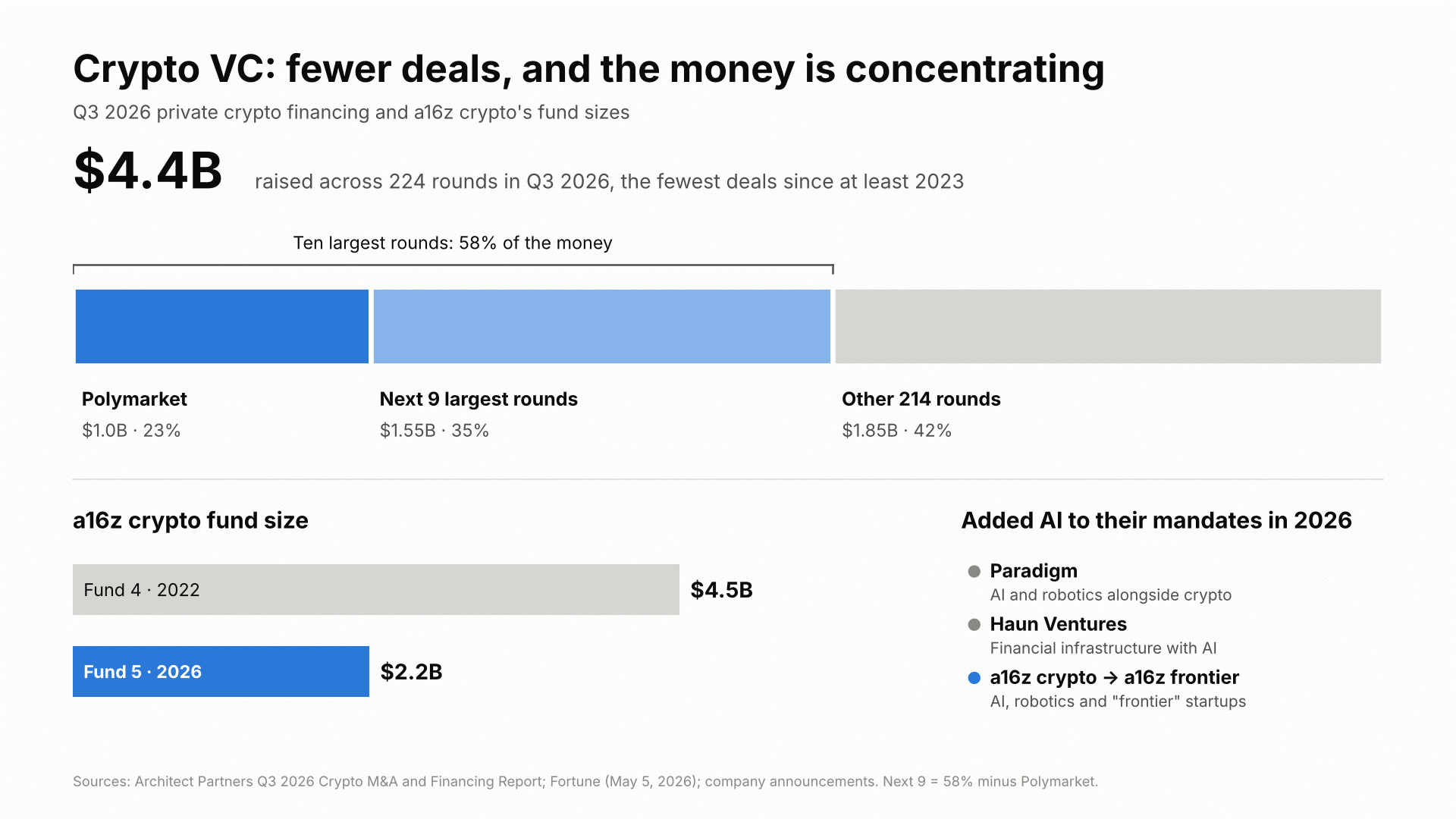
Fund sizing: Fund 5 at $2.2 billion is less than half the size of the $4.5 billion raised in 2022 for a16z crypto. A broader mandate increases deployment options amid fewer crypto deals. The move aligns with peers Paradigm and Haun Ventures, which added AI to their mandates in 2026.
New direction: crypto as AI payment rails
Thesis: Dixon frames blockchains as payment infrastructure for the AI economy. He cites fast, low-cost, global, programmable money rails; stablecoins becoming standard tools for fintechs and banks; and crypto enabling machine-to-machine transactions among AI agents.
Implication for crypto startups: funding priority likely for stablecoin payments and tools that enable AI agents to transact. Token projects without operating businesses will compete for attention with robotics and AI labs.
Team change: Ali Yahya, who joined in 2017 from Google Brain and later became a general partner, said he is moving to San Francisco to start a company. He did not link his departure to the rename. The fund enters its next phase without one of the architects of its crypto strategy.
Outlook: a16z spent eight years and $9.8 billion building a dedicated crypto platform. a16z frontier’s portfolio will indicate whether crypto remains a defined category for the firm or becomes one component within broader frontier technology investments.
Authors credited by the source: Daniel Francis
Published by Holder based on an external source.