Willy Woo presented 10,000 Bitcoin simulations showing $413,000 median December 2028 top
On-chain analyst Willy Woo posted 10,000 simulated price paths for Bitcoin on Monday, October 26, using a random-walk model trained on BTC’s history that embeds shrinking cycle returns to map potential tops and bottoms. The median path peaks at $413,000 in December 2028. Woo characterized the 28th to 50th percentile band as reasonable: a 2028 top between $241,000 and $413,000. He emphasized: this is a simulation, not a prediction.
10,000 POSSIBLE FUTURE PATHS
A random-walk simulation trained on BTC accounting for power law degradation of returns.
She's optimistic, I think between 28th and 50th percentile is reasonable.
i.e. 2028 top between 241k-413k
It's a simulation, NOT my prediction. pic.twitter.com/RpjaRKkSQJ
— Willy Woo (@willywoo) October 26, 2026
Market Intelligence: Crypto Analyst Predicts Best Low-Cap Crypto
Bitcoin News: What Did Willy Woo’s 10,000 Simulated Paths Show?
The model produces a rising staircase with deep steps. Each percentile path maintains a four-year rhythm: a top in late 2028 or early 2029, a bear-market low around April 2030, and another peak in February 2033.
| Path | 2028–29 top | April 2030 low | February 2033 top |
|---|---|---|---|
| 90th percentile | $1.44 million (March 2029) | $1.00 million | $5.80 million |
| Median | $413,000 (December 2028) | $234,000 | $1.03 million |
| 29th percentile | $241,000 (December 2028) | $126,000 | $477,000 |
| 10th percentile | $116,000 (December 2028) | $51,900 | $176,000 |
The spread dominates the conclusion. By February 2033, the 90th percentile is 33 times above the 10th. The 10th percentile ends 2033 at $120,000, but reaches a 2030 low of $51,900, about 35% below today’s price of $79,770.
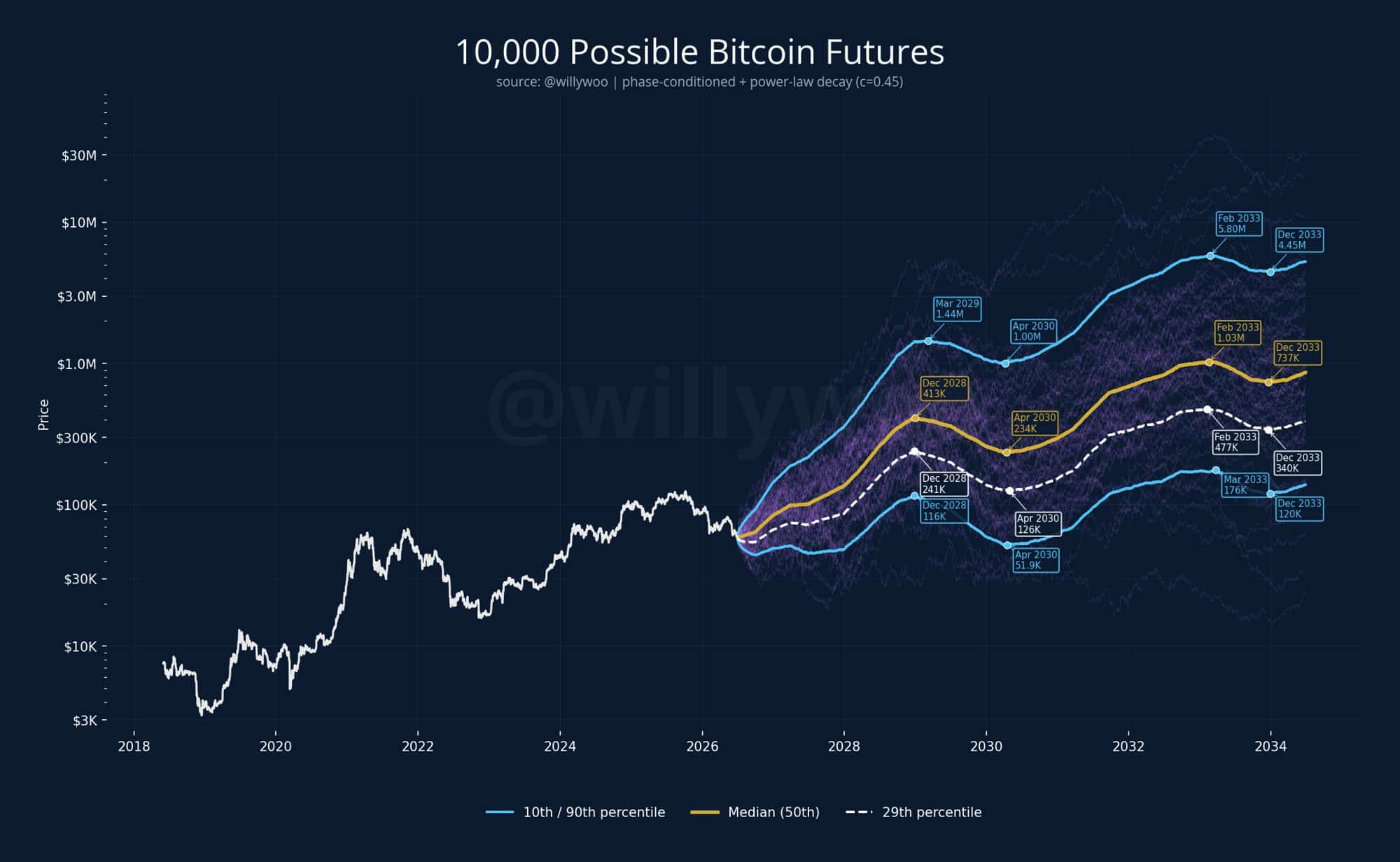
10,000 simulated Bitcoin price paths. Source: Willy Woo on X
Power-law degradation of returns: each cycle’s growth diminishes as market size increases and marginal capital moves price less. Historical tops support this: 2013 to 2017 rose 17x, 2017 to 2021 rose 3.5x, and 2021 to October 2025 rose 1.8x to $126,080. The model uses a power-law coefficient c=0.45 to set the fade rate. Phase-conditioned sampling selects daily moves consistent with position in the cycle, which aligns the paths to a four-year structure.
Against this history, the median path is generous. A $413,000 top would be 3.3 times the 2025 peak, nearly double the last cycle’s gain. Woo’s lower bound $241,000 equals 1.9 times the peak, close to the previous 1.8x.
What Does the Simulation Leave Out?
The model extrapolates past behavior and omits structural changes:
- New buyers: U.S. spot ETFs hold about $102.8 billion of Bitcoin. Strategy holds 848,517 BTC. These vehicles were absent in prior cycles and their flows do not align with halving dynamics.
- Rates and liquidity: the Federal Reserve raised rates in September and decides again on Wednesday. Past cycle tops coincided with easier monetary conditions.
- Supply: 20.1 million of 21 million coins are mined. Each halving cuts new supply by less in dollar terms as issuance shrinks.
- Rules and risks: regulatory shifts, competing assets, and technical threats such as quantum computing sit outside historical price-based models.
- Sample size: only four full BTC cycles to date. Ten thousand simulated paths still rest on limited historical anchors.
Conclusion: the chart maps possibilities, not targets, with no embedded certainty on price or timing.
Bitcoin Price Today: What Are the Levels to Watch?
Bitcoin trades at $79,770, down 2.1% over the week and 36.7% below the October 2025 record. It trades below the 50-day EMA at $80,765. Buyers defended $79,221 on Saturday and Monday.
Key levels: resistance at $81,480, then $82,850. Support at $79,221, then the 200-day EMA at $76,382.
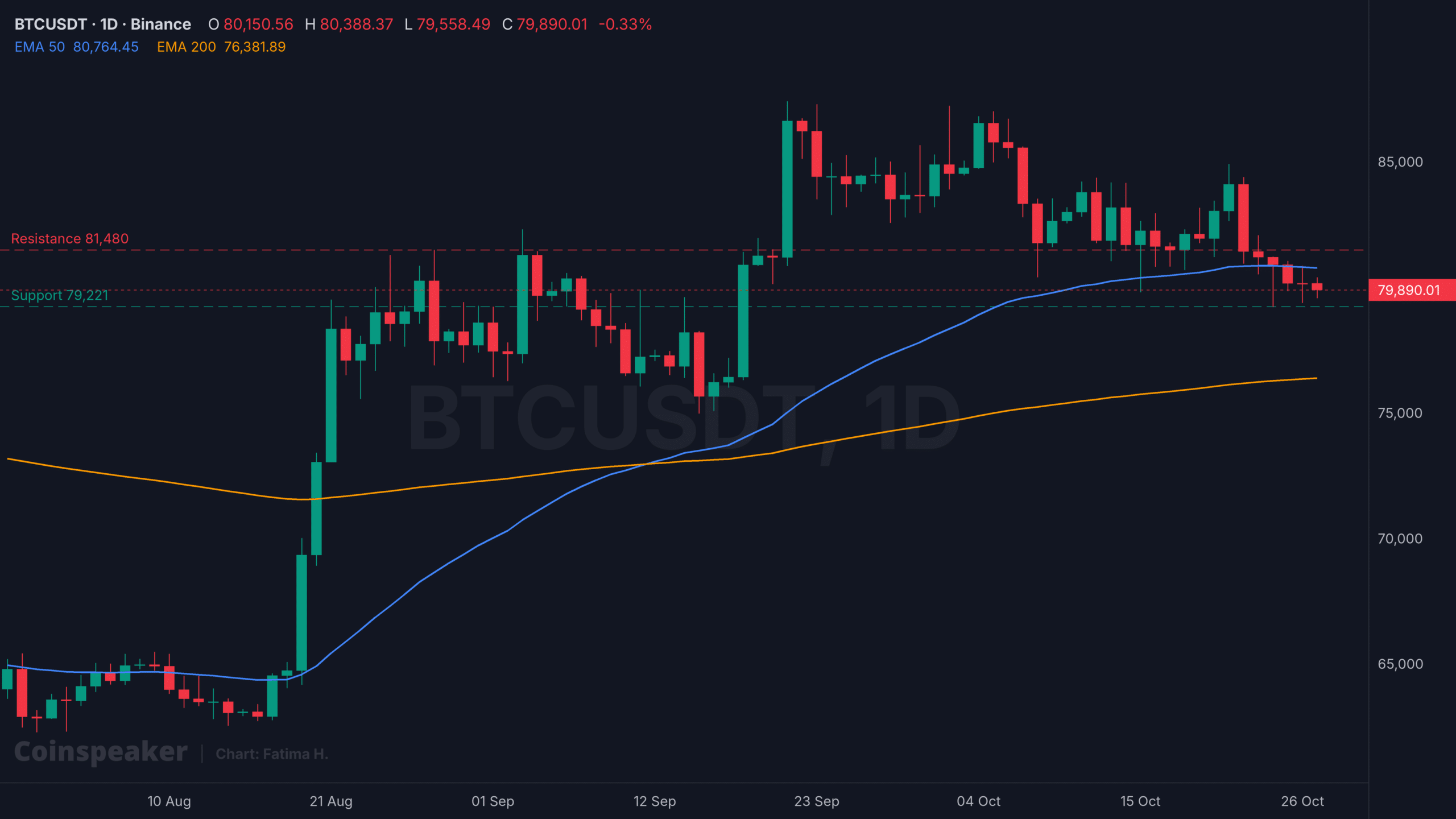
BTCUSDT 1D chart. Source: TradingView
| Scenario | What it takes | Where BTC could go |
|---|---|---|
| Breakout | A daily close above $81,480 | $82,850 |
| Range | Holding between $79,221 and $81,480 | Mean-revert around the 50-day EMA at $80,765 |
| Breakdown | A daily close below $79,221 | $76,382, the 200-day EMA |
To reach the low end of Woo’s 2028 band, Bitcoin must triple from current levels. Near term focus: whether $79,221 support holds through Wednesday’s Federal Reserve decision.
EXPLORE: Bitcoin Holds $79,200 Before the Fed, Coinbase Earnings and a $10.9B Expiry: Which Way Next?
The post appeared first on Coinspeaker.
Authors credited by the source: Daniel Francis
Published by Holder based on an external source.