Lummis warns CLARITY Act delay risks jobs, tax revenue until 2030
Sen. Cynthia Lummis warned on September 6, 2026, that if the current Congress fails to pass the CLARITY Act, the next realistic opportunity for comprehensive U.S. crypto market-structure legislation may not arrive until 2030. She linked a delay to potential losses of jobs, investment, and tax revenue, and urged lawmakers to complete work during the current Congress. The warning shifts attention to the legislative calendar: she frames inaction now as a multi-year delay in establishing a formal framework for digital assets.
CLARITY Act: Scope and Timing
The CLARITY Act is digital-asset market-structure legislation. It would introduce formal definitions for digital assets and apportion oversight between regulators based on classification. The bill assigns responsibilities to the Securities and Exchange Commission and the Commodity Futures Trading Commission according to an asset’s classification. Without the legislation, the SEC continues to apply the Howey test case by case without binding rules for the sector.
Lummis’s 2030 reference signals a potential timing gap based on legislative cycles, not a fixed deadline. A delay would postpone the establishment of definitions and a clear allocation of oversight between the SEC and CFTC.
If the Clarity Act doesn’t pass this Congress, the next real opportunity to bring market structure legislation back up is 2030. That’s years of jobs, investment, and tax revenue we can avoid squandering if we finish this now.
— Senator Cynthia Lummis (@SenLummis) September 6, 2026
Legislative Signals
White House crypto advisor Patrick Witt said CLARITY Act doubters will be proven wrong, with a Senate vote scheduled for September 15.
JUST IN: White House crypto advisor Patrick Witt says Clarity Act doubters will be proven wrong.
Senate vote scheduled for Sept. 15. pic.twitter.com/RHWg1nWHSZ
— Bitcoin Archive (@BitcoinArchive) September 7, 2026
Economic Stakes and Legislative Window
Lummis ties the timing to economic outcomes: jobs, investment, and tax revenue. Her claim is a conditional projection that reflects legislative and political cycles: missing the current window could push comprehensive market-structure action to 2030.
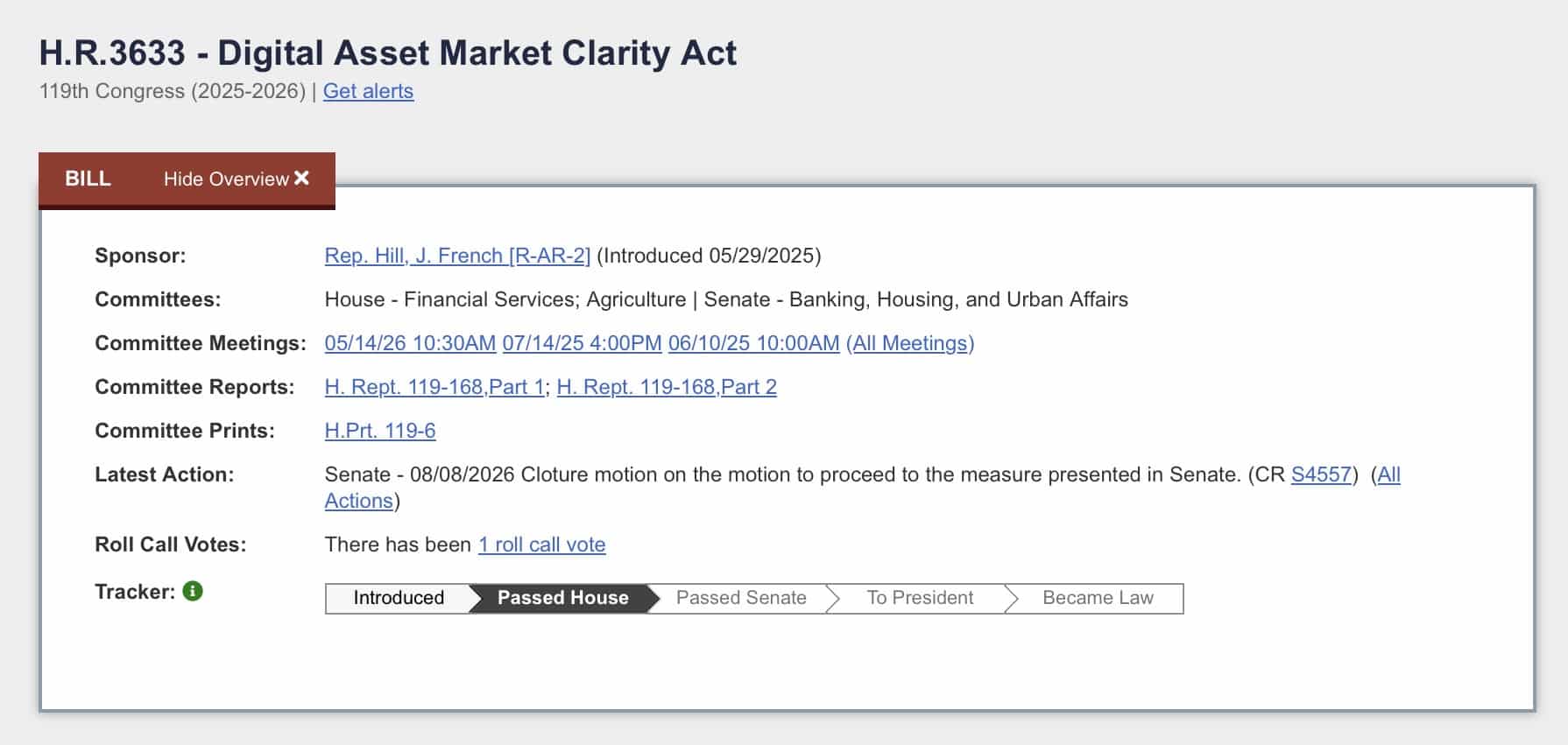
CLARITY Act Congress.gov
Key implications: the bill’s passage would create formal definitions for digital assets and clarify SEC and CFTC mandates. Failure to pass maintains the current regime under the Howey test without sector-wide rules, sustaining regulatory uncertainty.