

CoinShares says miners shift to AI as hash price hits lows
Hash price for Bitcoin mining fell to approximately $29–$30 per PH/s/day in early Q1 2026, down from roughly $36–$38 in Q4 2025, according to CoinShares’ Q1 2026 Bitcoin Mining Report. Listed miners could derive up to 70% of revenue from AI infrastructure by the end of 2026, up from roughly 30% today. The weighted-average cash cost of producing one bitcoin among publicly listed miners was approximately $79,995 in Q4 2025.
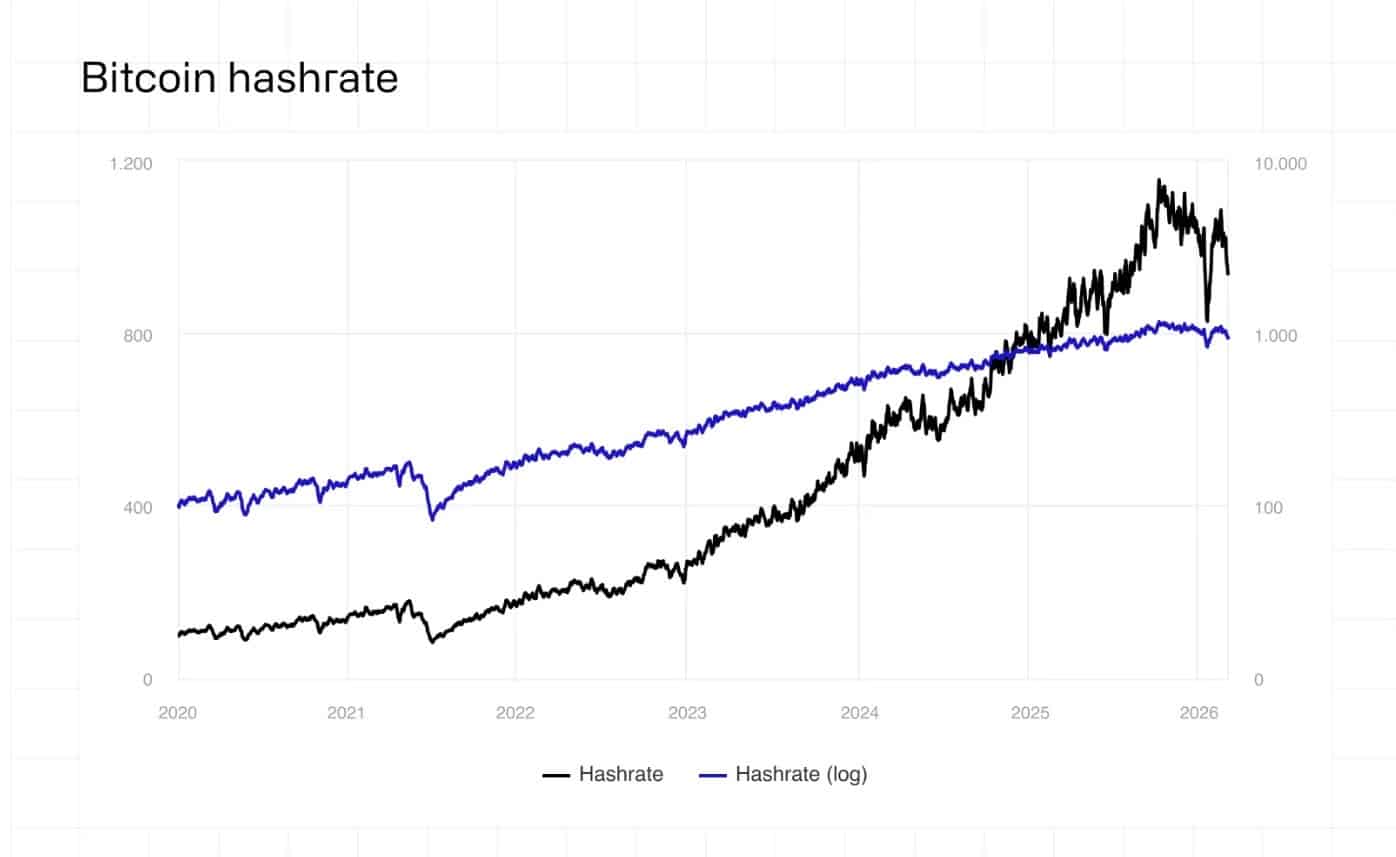
Bitcoin hashrate Coinshares
Pressure on mining arises from competing uses for electricity, rack space, and capital. CoinShares notes AI infrastructure offers higher and more stable returns while hash prices remain near cyclical lows. Miners with scalable energy access and data-center capabilities have an economic incentive to redirect resources toward high-performance computing. US mining infrastructure is not broadly retreating: the US share of global hash rate rose by roughly two percentage points quarter over quarter. The activity mix is changing as listed miners expand AI capacity while mining remains an important but pressured segment.
Bitcoin Miners’ AI Pivot: Infrastructure Economics
AI competes with Bitcoin mining for rack space, which could push mining toward intermittent, cheaper power sources. Listed miners announced more than $70 billion in cumulative AI and HPC contracts. Infrastructure costs differ sharply: Bitcoin mining infrastructure costs roughly $700,000–$1 million per MW, compared with approximately $8–$15 million per MW for AI infrastructure.
Company updates:
- Core Scientific: about 350 MW energized for HPC, roughly 200 MW billed; CoreWeave contract expanded to $10.2 billion over 12 years.
- TeraWulf: 39 MW critical IT capacity online at Lake Mariner; $12.8 billion in contracted HPC revenue.
- IREN: scaled to more than 10,900 Nvidia GPUs.
- Hut 8: signed a $7 billion, 15-year Fluidstack lease for 245 MW at River Bend.
AI and HPC revenue contributions are early but growing: AI/HPC colocation accounted for 39% of Core Scientific’s Q4 revenue; TeraWulf’s HPC business represented 27%; IREN’s AI Cloud segment contributed 9%; HIVE’s HPC business accounted for 5%.
Strategies differ: IREN and Bitfarms are repositioning as HPC providers while using mining as a bridge. CleanSpark prioritizes near-term mining while building AI exposure. Marathon deployed smaller containerized sites of roughly 10 MW suited to intermittent power. Mining can tolerate interruptions that AI workloads cannot.
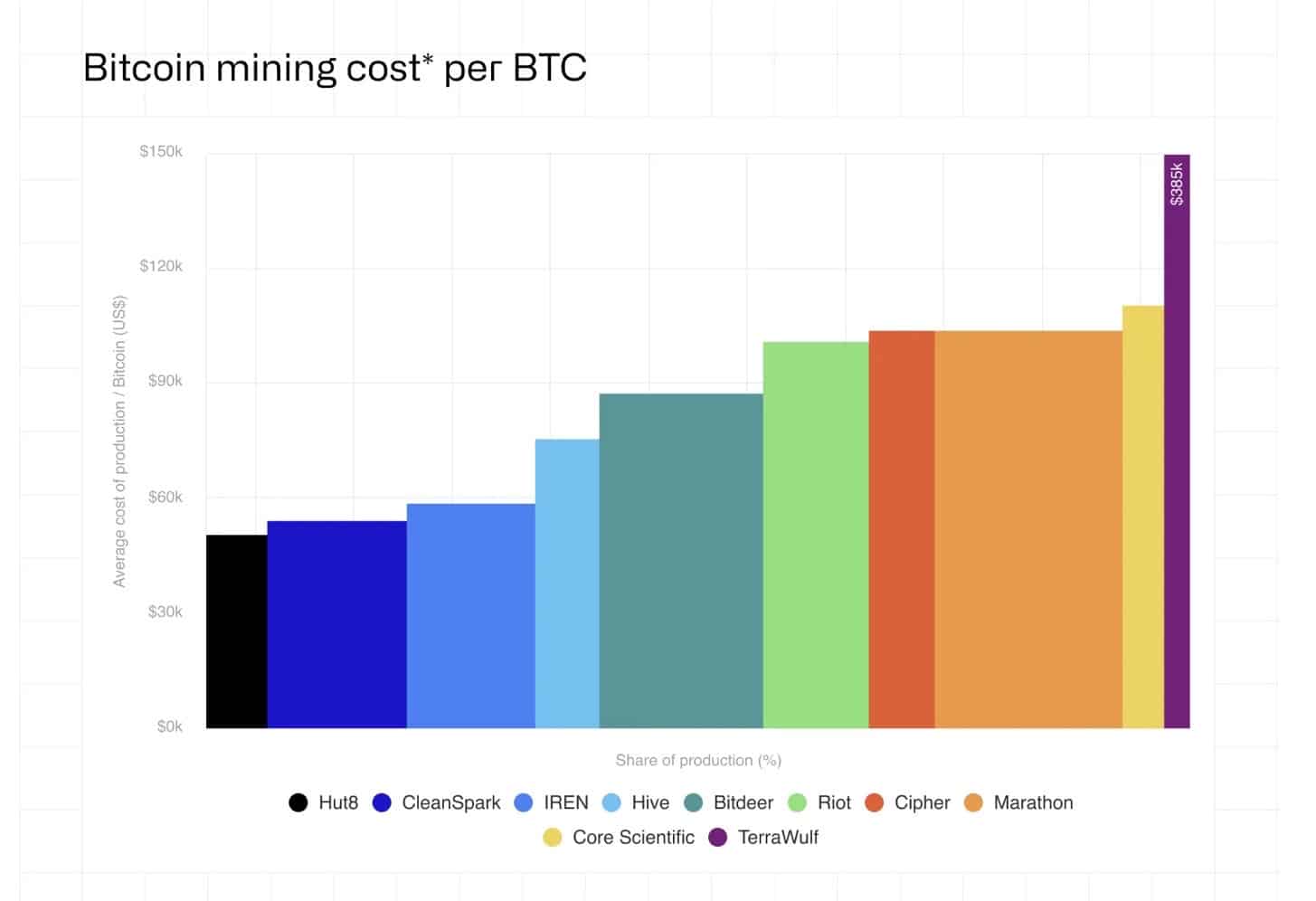
Bitcoin mining cost* per BTC Coinshares
Hash Price at Five-Year Low and Operating Thresholds
CoinShares called Q4 2025 the toughest quarter for miners since the April 2024 halving, driven by a bitcoin price correction, near-record hash rate, and three consecutive negative difficulty adjustments. The decline continued into Q1 2026, briefly touching $28 per PH/s/day in late February before recovering to $30–$35. CoinShares expects further capitulation among higher-cost miners in H1 2026 unless bitcoin recovers. Mid-generation hardware requires sub-5-cent power to remain profitable. Newer fleets below 15 J/TH retain healthier margins at typical industrial rates.
Accounting risks: AI/HPC buildouts can distort per-bitcoin cost figures for hybrid operators as debt, overhead, and depreciation tied to AI infrastructure get allocated against shrinking bitcoin output. Core Scientific’s failed merger with CoreWeave, rejected by shareholders on October 30, 2025, underscores this tension. CoinShares notes Core Scientific later restated financials after assets slated for demolition during HPC conversion were improperly capitalized.
7 miner wallets woke up after 16.5 years of inactivity and moved 350 $BTC ($28M) 6 hours ago.
These miners earned the 350 $BTC from mining in March 2010.
Wallets:
1LqKzBmdLGfEmvQPvzRQYBsb1VuBLFMeJ8
1Q9oY6c8T3KyjzrT7NVgx6qcoPXc3fU1R1
15VmQyGwCwiDmTk1e9jn2RbfGBLpusSJeP… pic.twitter.com/xa6c4NbqAf— Lookonchain (@lookonchain) September 6, 2026
Hash Price Scenarios and AI Pivot Durability
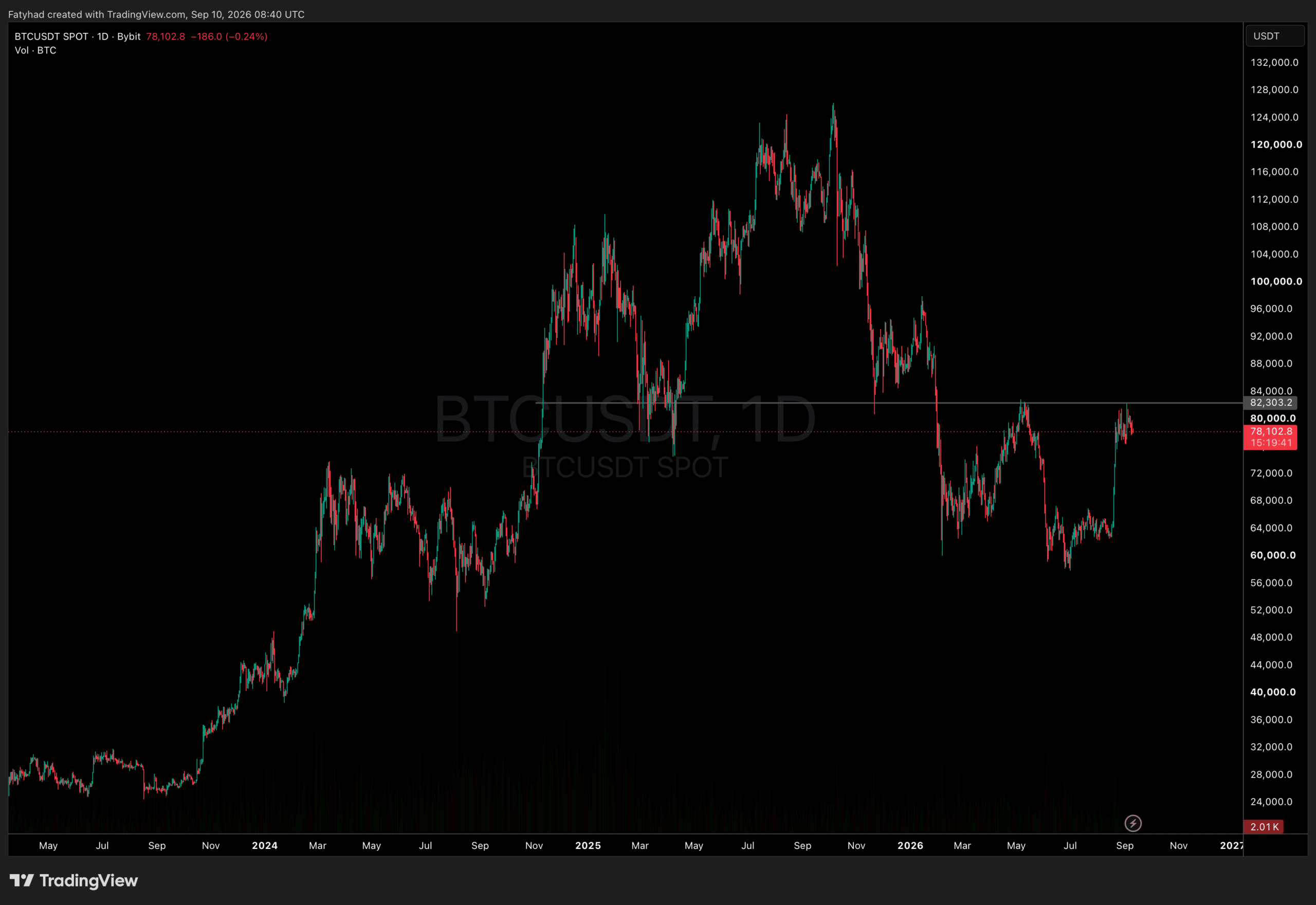
BTCUSDT Chart 1D TradingView
CoinShares estimates a sustained recovery above $40 per PH/s/day would require Bitcoin to rally toward $100,000 by the end of 2026 and to outpace continued hash-rate growth. If bitcoin prices remain below $80,000 for the rest of the year and difficulty rises, hash price could continue to fall. Additional rig shutdowns could reduce the hash rate and stabilize outcomes. CoinShares treats the AI pivot’s durability as an open question: a profitability recovery could shift capital back toward mining. Flexible power arrangements and low-cost, intermittent energy remain relevant for facilities unsuited to AI workloads.
Removed promotional content.
Authors credited by the source: Daniel Francis
Published by Holder based on an external source.