

Senate delays CLARITY Act, shrinking September window and lowering passage odds
CLARITY Act status: The Digital Asset Market Clarity Act remains a bill. The House passed it 294-134 in July 2025. The Senate did not hold a floor vote or file cloture before the August recess and set the measure aside, shrinking time for action before midterms. Majority Leader John Thune said it will go to the floor in September during a roughly three-week session that faces competing priorities. Prediction markets: Kalshi implies an 8% chance of passage in September, down from 10% yesterday. Of the $6.7 million traded, 54% expect passage by July 1, 2027.
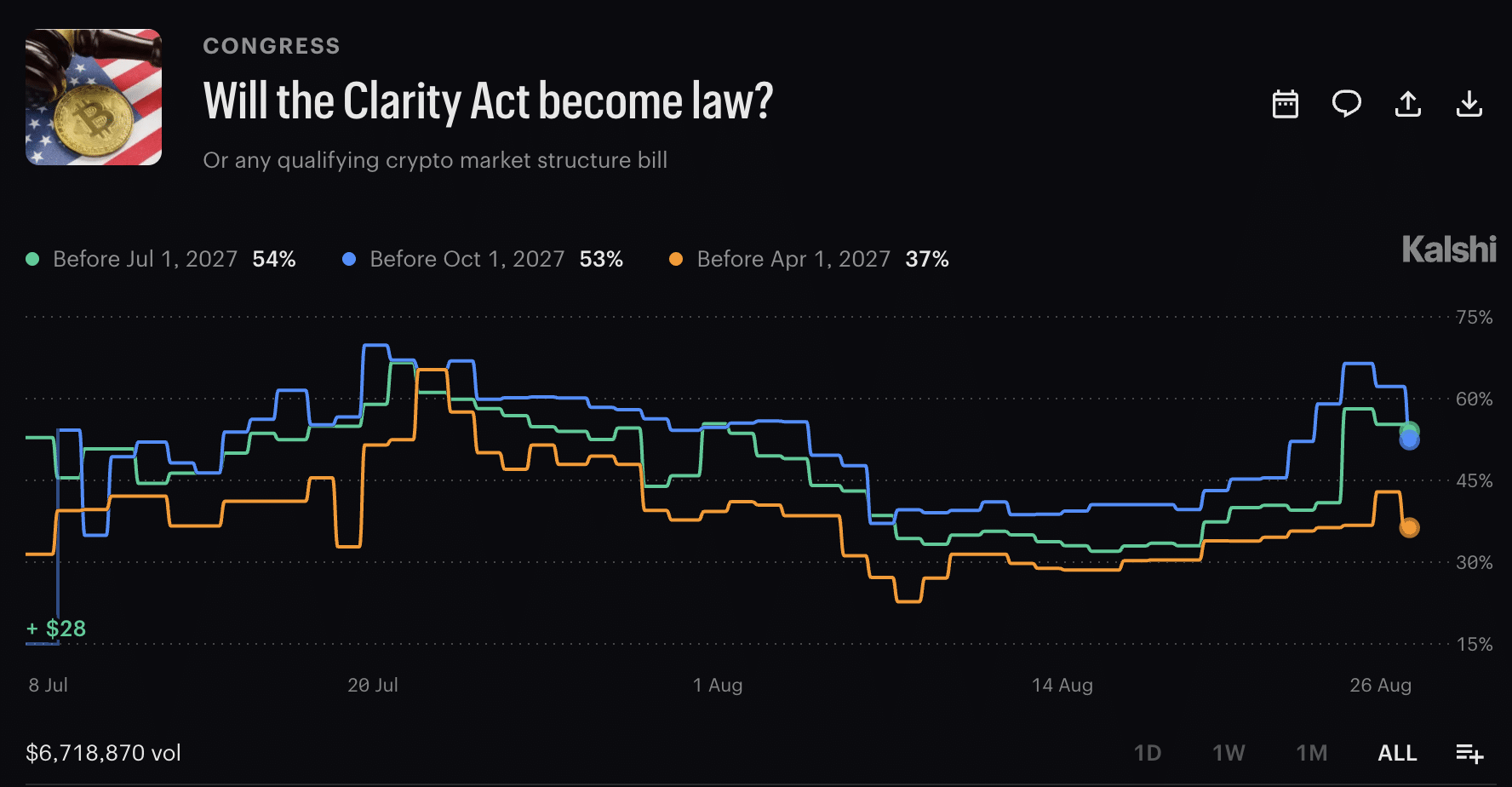
From House passage to a shelved Senate bill
The Senate Banking Committee advanced the bill with two Democrats in favor, making it eligible for floor consideration in June 2026. It stayed on the Senate Legislative Calendar through the first half of the year and was shelved in late July.
Core framework: The bill creates statutory categories separating digital commodities from securities and allocates jurisdiction to the CFTC for digital commodity spot markets and to the SEC for digital assets classified as securities. It establishes registration regimes for digital commodity exchanges, brokers, dealers, and custodians. These require subsequent rulemaking on registration, capital, custody, and conduct.
Additional provisions: a self-certification path for networks meeting statutory maturity criteria; protections for non-custodial software developers against money-transmitter treatment; federal preemption of conflicting state rules for covered assets and intermediaries.
Ethics dispute driving the impasse
The bill needs 60 votes to overcome a filibuster. Negotiations focus on an ethics provision restricting federal officials who issue or sponsor digital assets while in office. Republicans’ July 22 draft: a prohibition covering federal officials including the president, enforcement solely by the Department of Justice, penalties up to $250,000 per day, and a sunset on January 20, 2029. Democrats rejected exclusive DOJ enforcement and pushed for an independent role for state attorneys general. The two Democrats who advanced the bill in committee opposed the July 22 version. Sen. Cynthia Lummis continues work amid efforts to resolve the enforcement dispute.
US Regulators Could Move Without The CLARITY Act
BitGo CEO Mike Belshe warned during a recent interview that regulators may move without the Clarity Act.
His comments come as SEC Chair Paul Atkins and CFTC Chair Michael Selig signal similar plans. Both agencies have indicated… pic.twitter.com/An2e9JbL4O
— BSCN (@BSCNews) August 26, 2026
September window and alternate paths
The September session offers limited floor time and faces appropriations deadlines and other priorities. Any Senate-passed version would still require House concurrence. Ian Katz of Capital Alpha told The Hill that prospects weaken as September approaches due to few legislative days and competing issues. A year-end strategy has been floated: attaching the bill or components to must-pass legislation such as appropriations or the defense authorization. No senator has confirmed this approach, and it would not resolve disagreements over votes and enforcement.
The post appeared first on Coinspeaker.
Authors credited by the source: Daniel Francis
Published by Holder based on an external source.