BlackRock-led Bitcoin ETFs take $424 million and BTC slips under $80,000
U.S. spot Bitcoin ETFs logged a third straight inflow day on October 28: $137.3 million, lifting the three-day total to $424 million. The Federal Reserve kept rates at 3.75%–4.00% with a 10–2 vote, and markets now price a December hike near 77%–79%. Bitcoin’s post-Fed bounce to $81,788 faded during Asian hours as a chip-stock selloff spilled into crypto, sending BTC to $79,710. BTC trades near $79,899, down 1.2% on the day and 4.4% month to date, with October tracking a second consecutive losing October.
ETF flows: scope and context
- In three sessions through October 28: $424 million of net inflows, almost entirely via BlackRock’s IBIT.
- Daily breakdown: Monday $110.3 million to IBIT; Tuesday $176.0 million across all 12 funds with no outflows; Wednesday $137.3 million with $136.0 million to IBIT and $1.3 million to BITB.
- After a $635.6 million daily outflow on October 22 and a weak start to October, cumulative October flows flipped slightly positive by roughly $110 million.
- Aggregate holdings: $104.9 billion across 12 funds, about 6.4% of Bitcoin’s market value. Net inflows since January 2024 launch: $57.6 billion. IBIT AUM: $66.1 billion.
Fed decision and market reaction
- Policy: Rate hold at 3.75%–4.00%, with dissents from Governor Lisa Cook and Cleveland Fed President Beth Hammack favoring a 25 bp hike.
- Statement: The economy is expanding at a strong pace; inflation remains elevated; future moves depend on incoming data.
- Chair Kevin Warsh: No forward guidance; politics not a factor before midterms.
- Market pricing: Polymarket implies a 77% chance of a December hike, little changed.
- BTC price action: Flat to modestly higher post-announcement, then declined during Asia hours alongside semiconductor weakness. About $350 million in leveraged crypto positions were liquidated over 24 hours.
November catalysts and seasonality
- October 29: Core PCE inflation and Q3 GDP at 8:30 a.m. ET; Coinbase and MicroStrategy earnings after the close.
- October 30: Deribit monthly options expiry, about 135,700 BTC in open interest, roughly $10.8 billion notional.
- November 3: U.S. midterm elections.
- November 6: October nonfarm payrolls.
- November 10: October CPI per BLS calendar; September CPI was 3.7% year over year.
- December 9: Next Fed decision.
Seasonality since 2018: BTC rose in three of the last eight Novembers. Large gains occurred in 2020 and 2024 after presidential elections. Midterm years 2018 and 2022 ended November down 36.6% and 16.2%. Sample size is limited, and both midterm Novembers fell during bear markets. Options-implied volatility is subdued: Deribit DVOL at 36.5, slightly below the recent 37–39 band.
Price levels: support, resistance, scenarios
BTC trades below the 50-day EMA at $80,789 and is testing the October 24 low at $79,221. The 200-day EMA has risen to $76,476. The 50-day crossed above the 200-day on September 12.
- Resistance: $84,898, the October 21 high.
- Support: $79,221. Below that: $76,264–$76,476, spanning the September 2 low and the 200-day EMA.
| Outlook | Trigger | Level to watch |
|---|---|---|
| Rebound | Daily close back above the 50-day EMA at $80,789 | $84,898 |
| Holding pattern | Range between $79,221 and $84,898 | Sideways trade near the 50-day EMA |
| Sell-off | Daily close below $79,221 | $76,264 to $76,476 |
Summary: ETF demand returned this week, but the Fed left December contingent on data and cross-asset risk remains influential. Near-term tests: PCE inflation today and the November 6 jobs report.
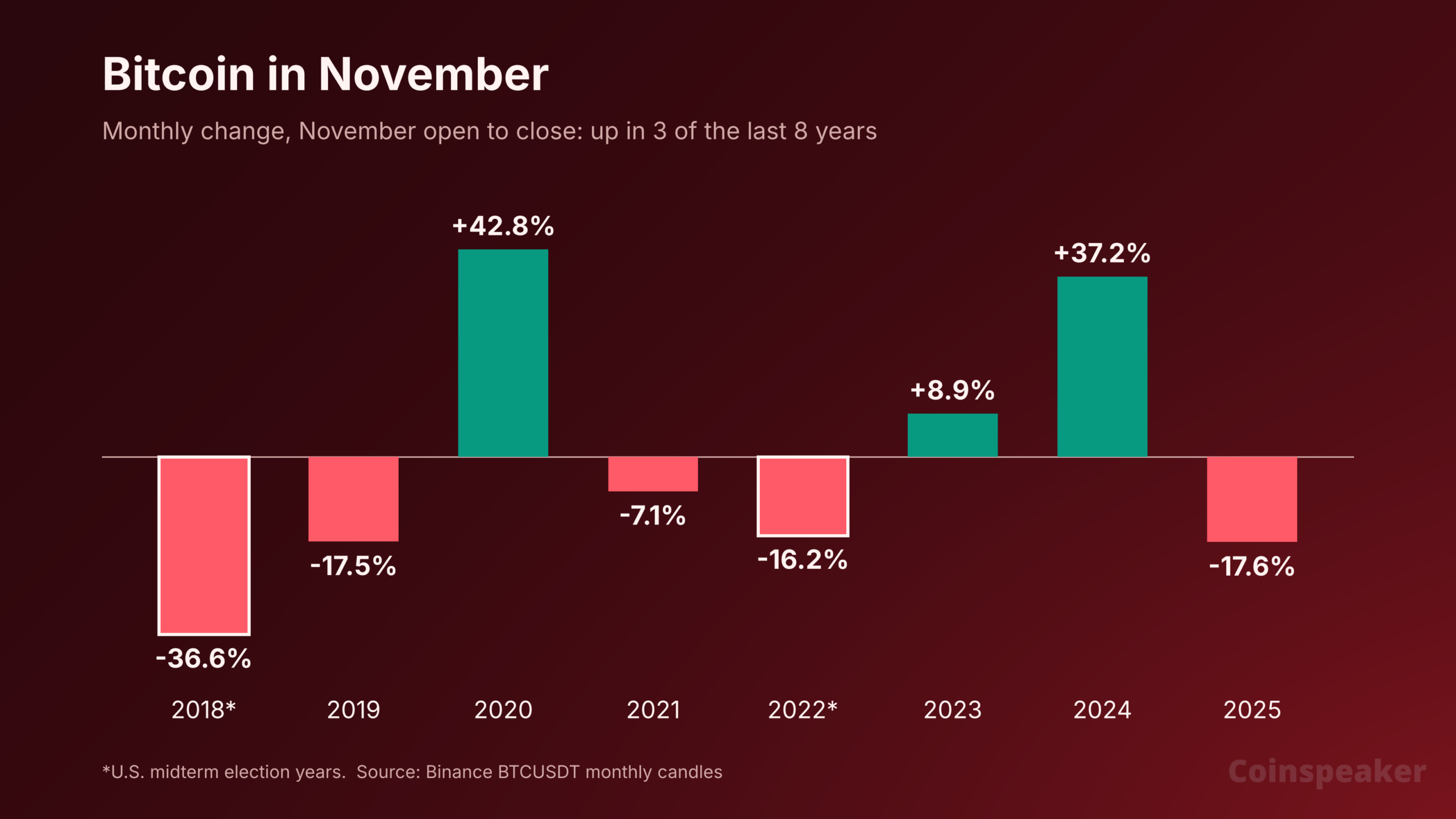
Bitcoin’s November returns since 2018. Source: Binance
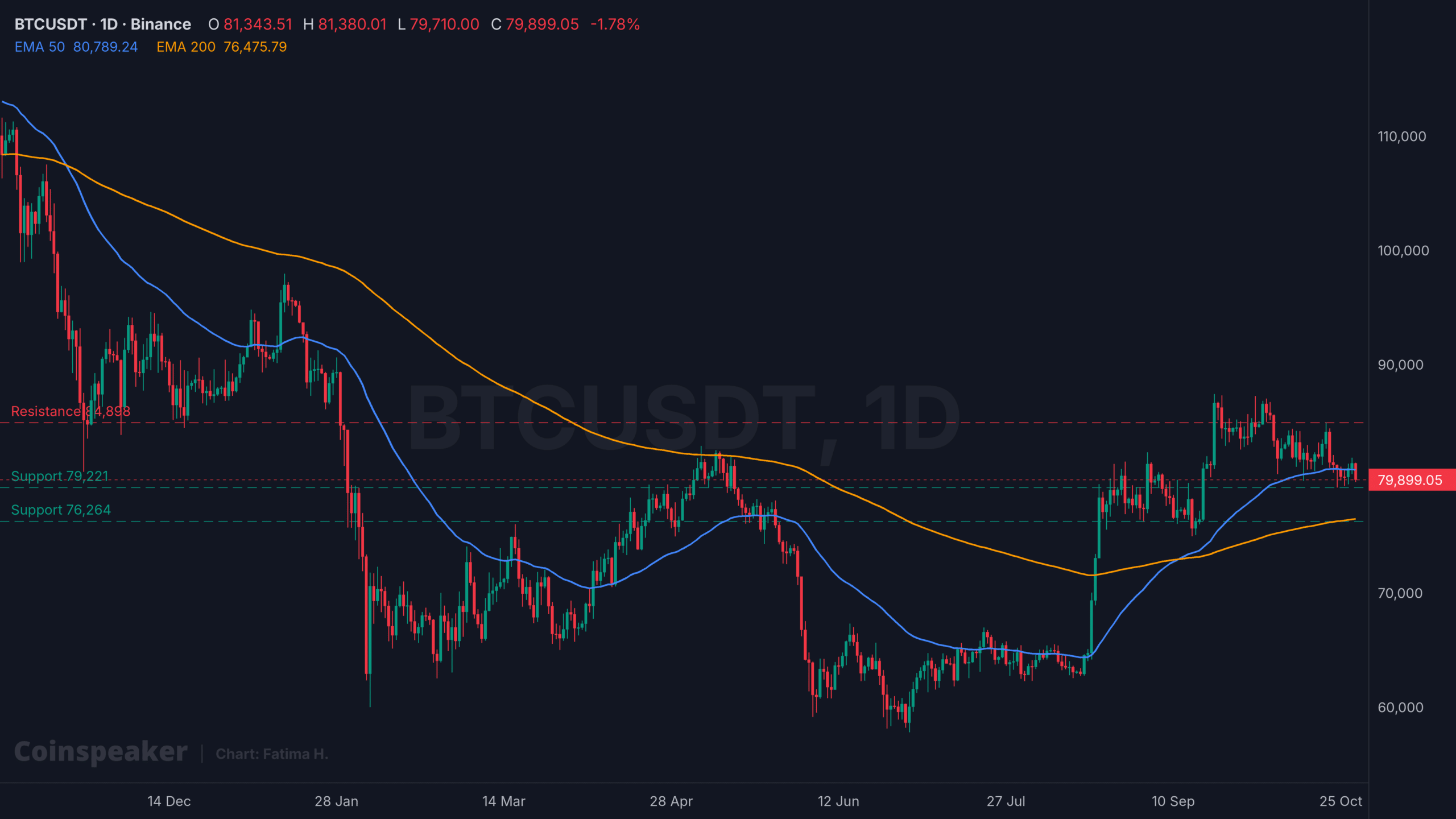
BTCUSDT Chart 1D TradingView
Authors credited by the source: Daniel Francis
Published by Holder based on an external source.