
12 0
Ethereum gains advantage as modular design turns layers into markets
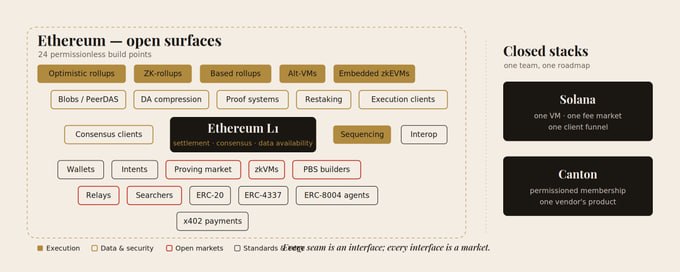
Ethereum’s moat: modular design turns each layer into a market
Ethereum separates execution, settlement, data availability, and consensus. Any team can improve a layer without core protocol approval.
This widens the “innovation surface.” Interfaces become industries.
- Rollups, DA, restaking, ZK proofs, MEV, clients, wallets, intents, interoperability, and token/account/AI‑agent standards now compete as distinct markets.
- Monolithic chains ship speed fast. Solana shows the blockspace throughput upside of this strategy.
- As throughput gets cheap and abundant, the edge shifts from raw speed to neutrality, flexibility, customization, and openness. Think IBM mainframes versus modular PCs, proprietary networks versus TCP/IP.
- Monolithic chains need one team to stay best across the full stack. Ethereum minimizes the core and lets thousands of teams compete per layer.
- Ethereum’s moat compounds: external builders make the network more valuable. You can copy performance, not the accumulated innovation surface.
Authors credited by the source: dolbikong
Published by Holder based on an external source.